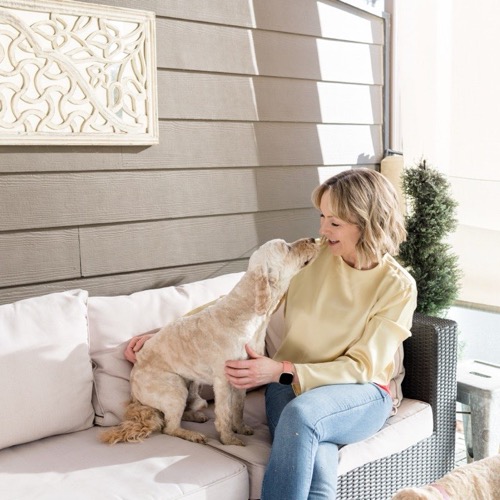
3 Trainer Tips For Dealing With A Dog Who's Super Attached To You
Show Notes
In this episode, I’m going to talk about how you know when you’ve got one of these hyper-attached dogs.
And I’m going to share my top 3 tips for how to handle it.
Transcript
Download SRTYou're listening to another episode of the Fixing Separation Anxiety Podcast.
I'm your host Julie Naismith and this week we're talking about what to do
when for your dog it is all about you.
Hello and welcome to the Be Right Back Separation Anxiety Podcast.
Hi, I'm Julie Naismith, dog trainer, author and full-on separation anxiety geek.
I've helped thousands of dogs overcome separation anxiety with my books,
my online programs, my trainer certification and my separation anxiety training app.
And this podcast is all about sharing my tips and tricks to help you
teach your dog how to be happy at home alone too.
Now we all adore dogs and one of the big reasons that we love them so much
is because of the unconditional love they give us.
But when that love turns into a laser focus just on you,
when it's all about you and no one else will do,
that love becomes freedom limiting and it becomes a problem for both you and your dog.
In this episode I'm going to talk to you about how you know when you've got one of these dogs,
these hyper-attached pups, and I'm going to share my top three tips for how you can deal with it.
Okay, so first off, what are the signs that your dog is hyper-attached to you?
First off, number one, you can't go anywhere in the house without your shadow dog being
under your feet. Everywhere you go there's your shadow dog.
They follow you around, they're in every room that you're in,
every time you look over your shoulder you can see your dog.
Now we often assume that dogs who do this, dogs who follow you everywhere,
are anxious about being apart from you but it's not necessarily the case.
Just because a dog follows you everywhere doesn't mean to say it has attachment that is of
a problem level. So it doesn't mean to say that the attachment is an issue just because your dog
follows you everywhere because lots of dogs follow people, lots of dogs follow us.
We are the source of all things fun and interesting so why wouldn't they?
Why wouldn't they follow us when we open the cupboard where the kibble is kept or
why wouldn't they follow us into the bedroom because they think they might be able to have
a snooze on the comfy bed and get a belly rub and some ear scratches.
Lots of dogs will follow their owners just because fun things happen when owners are around
but the difference between the dogs who follow you because they're curious or because they think
something good is going to happen and the ones who cannot leave your side because if they do
they go into a panic is the anxiety level. So some dogs will follow us but they are
totally fine not being with us, they'd just rather be by our side. Some dogs cannot be
without us, they cannot cope if they are not with us and that's the key difference.
So just because your dog's following you around doesn't mean to say that it's in a panic when
separated from you. It's really important to remember that and just because your dog follows
you doesn't mean it's a problem. For lots of people having a shadow dog isn't an issue so
it's only an issue if it becomes a problem in our lives, if we see it as a problem, if it
interferes with things that we want to do, if we're just desperate to have a shower in peace
and we can't do so because our panicky dog will not let us do so then it becomes a problem.
And with a dog who's nosy or curious, so the ones who are just following you because something good
is about to happen, it's easier to get them to stop following us to the shower or to the bathroom.
We can try things like keeping them occupied in another room maybe with a food puzzle
or we can teach them a really nice down say on their mat in another room or in a different part
of the room. So it's easier to change the behaviour, the following behaviour for the
dogs who are just curious or interested or want to know what we're up to. And we can teach those
dogs, so basically we can teach the dogs who follow us around but who aren't anxious, we can
teach them that being in another part of the house is just as rewarding as being under our feet.
But that's much harder to do with anxious dogs and later on I'm going to talk about how and when
you might address this. So a second sign that your dog might be hyper attached to you is that when
you try to leave the house, so not just move around the house, but when you try to leave the house
your dog's panic really kicks in. Not only is your dog not able to be left alone in the house but it
freaks out even if someone stays with them. The problem for the dog is that the person who stays
with them, whether that's the sitter, whether that's a friend, big problem for the panicky dog
who cannot be separated from you is that the someone who stays with them isn't you and they
cannot handle that, they can't cope with being separate from you. Now luckily most people dealing
with dogs who have separation anxiety are not dealing with a dog who panics when apart from one
or two significant people. Instead most dogs who struggle to be home alone are fine as long as
anyone, any warm body, any person, as long as anybody is with them. Not usually an animal,
usually has to be a human, but they tend to be fine as long as anybody is with them. So in my
experience I have no doubt, I've seen time and time again that the dog who needs to be with their
owner 24-7 is a harder case. It's a harder case of separation anxiety to resolve. Well why is that?
So let's remind ourselves of what it takes to get a dog over separation anxiety. In order to teach
a dog that it's okay to be alone we have to keep them under their anxiety threshold 100% of the
time while we gradually get them used to being on their own. And with a typical separation anxiety
dog owners can enlist sitters or send dogs to daycare, use dog walkers, get family, friends
involved. So there's a range of options for owners whose dogs are okay as long as someone is with
them, just someone, not you, just someone. But with a dog who is extremely attached to one person,
maybe a couple of people, being with anybody else brings on anxiety. So they are not okay,
they are not 100% fine as long as someone is with them. They're only 100% fine if the special
person or persons in their life is with them. So all those situations where we're enlisting
help to manage absences, all those situations can result in a dog who goes over threshold and
becomes anxious. So we are now no longer managing our dog's threshold and keeping them under their
anxiety threshold the whole time because it's actually totally impossible unless you want to
stay with your dog 24-7 which just doesn't make any sense. So what can you do? If this is you,
what can you do? Well like I said it doesn't make any sense to expect you to be with your dog 24-7
and actually I think it's totally unreasonable. It's ridiculous in fact and if we put those
demands on you then actually it's more likely that you're going to fail. It's more likely that
separation anxiety training will fail because it's an unattainable goal and you're just going to feel
overwhelmed, you're going to feel like it's just totally out of reach. Over time when I've worked
with clients who struggle in this way, whose dog is all about them, I've noticed that there are
some things that we can do that help change up the situation, that change the dynamics,
so that we can make progress with home alone training. Here are my top three tips for helping
these attached dogs progress through training. What you need to do is you need to implement
these tips alongside traditional separation anxiety training which as a quick reminder
is gradually getting your dog used to being home alone by exposing your dog to home alone time that
it's comfortable with, tiny tiny amounts, and then ever so slowly increasing that time making
sure that your dog is under threshold all the time. So I'm going to assume that you're working
on that training, so these three tips are supplements to that training. Okay, make sense?
Right, first off, spread the love. I call it spread the love. Now I stole this idea from the world of
child psychology. In some families children, a child, can become overly attached to one parent
over another. So it might be that your child, that a child becomes really attached to dad
and when it comes to mum having to take them swimming, the child doesn't want to go. The child
doesn't want to go because mum's taking them swimming and the child wants to go with dad.
So that becomes problematic in a family situation because the child favours one parent so strongly
that not being with that parent causes a huge amount of distress and anxiety.
So what happens when that situation arises is that the non-favoured parent is encouraged to
get more involved in fun activities and then the favoured parent is encouraged to reduce
involvement in fun, loving, connected activities. So we're really spreading the love around
and that seems to help some children in that situation. So with separation anxiety in dogs,
what I advise is getting about two to three other people involved in the dog's caregiving. So two,
three people who will do more of the fun stuff in the dog's life. Meanwhile, I encourage the
current main caregiver to reduce their involvement which can be hard. It doesn't mean to say you've
got to ignore your dog but it just means that you need to dial down your involvement while you let
other people step up. Because the goal that we have for the dog is for them to see that they
don't need to rely on just one person, on just you, for good things, for fun things, for exciting
things to happen. And we want to show them that they can be safe with others. And those two or
three people, the extra caregivers, they don't have to be members of your family, they don't
have to be people living in your home. They might be your dog sitter, they might be a particular
member of staff at daycare, they could be a friend. But the key thing is you want to make
sure that these people can commit to being a pretty permanent part of your dog's life. You
don't want to undertake this exercise only to find that your dog sitter gives up dog fitting in six
weeks time. I know you can't predict that but you want to try and find people who can be relatively
stable in the dog's life. You're going to invest time, you're going to invest training and possibly
money if you're paying a dog sitter to get involved in the spread the love approach. You also need to
think about how do you select these people. I do have some guidance on that because you'll be more
successful if you select the two or three people in a certain way. And that brings me on to tip
number two. I'll tell you how you select these people as I go through tip number two. And tip
number two is all about finding the least worst alternative to you. So I get what I do with this
is I get clients to do an exercise whereby they rank different scenarios in their dog's life from
the thing that's scariest to their dog to the best. And by scenarios I mean alone scenarios or
caregiving scenarios. I'm not talking about whether the dog's frightened of people or whether the dog
doesn't like the vet. I'm talking about in the particular context of being alone or being
separate. So for a dog who doesn't like being apart from their owner the scariest thing though
isn't necessarily being apart from their owner it's being on their own because on their own is
being apart from their owner and with no one else around. So in the vast majority of cases that I
work with the scariest scenario is being totally alone. And then at the other end of the spectrum
the best scenario for these dogs of course is being with their special person, of course it is.
But there are degrees in between and that's what we work with, that's what we play around with.
So for example maybe they get stressed when they are left with a dog sitter but maybe that's not
as stressful for them as when say they're at daycare. So dog sitter might be a little bit
better for them than daycare. Not all dogs, I mean some dogs are only better at daycare than they are
at the sitter. So you have to work out what's the rank order for my dog. Another example might be
maybe they're okay with your partner but that okay is better than when they're say with your parents.
They might be you know not brilliant with your partner because when you're not around
but they're better with your partner than when they're with your parents. So you come up with
that rank order, the scenarios in your dog's life. Start with the worst, most likely when your dog's
on its own and go up to the best, probably when they're with you and work out what are the in
between steps. What I want you to do is I want you to choose the scenario that's least worse. So say
you rank everything out and it turns out that your dog, although not as comfortable with you,
with just you, your dog is actually okay-ish with the dog sitter. So that would be your first,
your preferred option for care and that links back to tip number one, like who are the people
that I should invest in spread the love training, who I should get invested in spread the love
training rather. Well you're going to pick people that are in your least worst scenario rank order.
So it could be the dog fitter, dog walker or whatever. So go with the people whom your dog
already has some connection, seems to do okay with and seems to prefer being with to being alone.
Okay so that's how you'd link tip number one which is spread the love with tip number two,
find the least worst alternative to you, to being without you. And then number three,
I'm going to use medications. That's a massive, massive part of helping these dogs. Now most
dogs benefit from medication, most separation anxiety dogs that is, benefit from being on
anxiety medication to help with their training. But for dogs who are only ever okay if they are
on their own with one person, medications are an absolute must. So the medication that would
work for these dogs, it could be either a daily medication or it could be a situational med. So
something that's given on an ad hoc basis or it could be both, it could be combination therapy.
What I've seen work particularly well is a situational med for when a dog is not with you,
but isn't alone, but it's just not entirely comfortable in the step in between being with
you and being alone. So the dog sitter or the daycare. So maybe in that situation, a situational
med can help the dog and help your dog be less stressed when they are with somebody, but that
somebody is not with you. And that's going to help you keep your dog under threshold even when you
are not there. So it's not about your dog being alone, it's about your dog being anxious when
you're not around and using medication to make your dog more comfortable with alternative
caregiving arrangements. And if you do that, you've got a much better chance of keeping your
dog under threshold and that means you've got a much better chance of getting the sub-threshold
training to work. If you've never considered medication for your dog and you're struggling
with separation anxiety training and you've got a dog that is really, really attached to you,
I'd say now is absolutely the time to go and chat to your vet. So just to recap on my three tips.
Number one, spread the love. Number two, find the least worst alternative to being without you.
Number three, use medications. So to sum up then, if you have one of these extra over-attached dogs,
it is going to be more of a challenge to get your dog over separation anxiety. Now I've just seen
that time and time again. It is going to be harder. I can't sugarcoat it, but it is doable.
I do see these dogs get over separation anxiety. So use the tips and don't give up hope. Even if
the training is tough, it just means you've got to be a little bit more creative. You've got to try
things a slightly different way to earners with the more common form of separation anxiety,
which is just not being able to be home alone. And don't give up. Yeah, don't give up because
you can get there. Now, don't forget, if you need support, you can join my free separation
anxiety support group, my Dog Separation Anxiety Support Group on Facebook. And if you need extra
support on top of that, you can join the Separation Anxiety Heroes Club. Now, my Heroes Club is a
private members club where we focus on separation anxiety training, but also on motivation,
on troubleshooting, and just getting you to stay the course. I open the doors four times a year.
Doors open again on September 30th, but you can join the waitlist by visiting
www.separationtraining.com forward slash waitlist. Okay, that's it for me. I really
hope you find these tips useful. If you've got one of those dogs that just cannot bear
to be apart from you. If you've enjoyed this episode, if you like this podcast, I'd love it.
I'd be so grateful if you'd go over to iTunes and rate and review. Meanwhile, thanks again
for listening. I know you have lots of choices when it comes to podcasts. So I do truly appreciate
you listening in and I will be back next week with another episode of Fixing Separation Anxiety.
I'll see you then. Thank you so much for listening to this episode of the Be Right Back
Separation Anxiety podcast. If you want to find out more about how I can help you further,
head over to julienaysmith.com. Meanwhile, if you enjoyed listening today, I would love it if
you would head over to wherever you listen to your podcasts and consider rating my show.
Thanks so much. Good luck with that training and bye for now.
Need help with separation anxiety?
Join the Be Right Back program and get the support you need.
Start helping your dog today