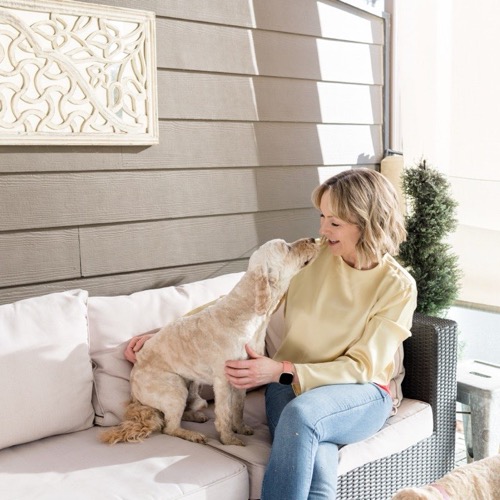
Not One, but TWO dogs with SA—How Jen Struggled, Managed and Succeeded
Show Notes
In this podcast, I interview Jen Sadler, the owner of Gus, the amazing Shih Tzu Tibetan Spaniel cross. Jen’s hard work helped Gus triumph over his separation anxiety. Their journey was not a short one. But after the span of a year, and despite the adoption of another dog with separation anxiety (!), the whole family is now in a very happy place.
Transcript
Download SRTWelcome to the Fixing Separation Anxiety Podcast, where it's all about healing your dog, regaining
your freedom, and getting your life back on track.
And now, here's your host, Julie Maismith.
So today I've got somebody really special here with me.
I've got Jen Sadler.
Now Jen is an amazing guardian owner of a dog called Gus.
And today, Jen is going to tell us Gus's story, because I think you are going to love it.
So hey Jen, how are you?
Hi, Julie.
I'm great.
It's so great to be here.
And Jen, tell us whereabouts in the world you are.
We're in Brisbane, Australia.
And you've got Gus, and you've also got little Molly, right?
That's right.
We've got Gus first, and we then got Molly later.
And today we're going to be talking about Gus, but we are also going to talk about Molly
too, because she's a part of this story.
All right, Jen, let's start from the beginning.
You and I have been working together for just over a year now, haven't we?
But go back to the start.
Tell us about how Gus came into your life, and a bit about that first period with Gus.
Sure.
So we were very new to dog ownership.
We had never owned a dog in our family before, and I travel a lot for work, and we had some
changes in our lifestyle that made us think now is the time to get a dog.
And we looked for a rescue dog initially, so we could adopt, not shop.
And we couldn't find a dog to join us in our home, so we ended up seeing a breeder instead
and buying a puppy.
So we bought puppy Gus.
He is a Shih Tzu Tibetan Spaniel, and he came to us when he was 10 weeks old.
And we were really foolish in our initial beliefs about what dog ownership was going
to be like, and we saw all the families out and about the park with their dog, and they
were all happy, and their dogs were playing fetch and running back to their owners and
didn't notice anything going on around them.
And we had friends who would come and visit us, where a pal was on end for a few drinks
on a Saturday afternoon and leave their dog at home, and then pop back home to their dog
later.
And we envisioned this amazing life.
Which seems reasonable, right, especially to being able to go out to dinner and have
a couple of drinks while your dog sleeps away the whole time at home.
Doesn't seem unreasonable.
That's what we thought.
We thought that our life was going to become some activities with our dog and continue
some activities without our dog.
And then, at some point, you started thinking, hmm, this isn't quite how we thought it was
going to be.
So when did that happen, or how did that happen?
That's right.
So when Gus joined us, I had actually just had major surgery, and I was home off work
for nine weeks in recovery.
And we thought that this was the right time, that we would have the time to settle Gus
into our home.
And so I was home for a couple of months with him, and he wasn't left alone at all.
And so then when I started to return to normal life physically, I would take my child to
swim squad, or I would go to the grocery store, or we would go out to the movies.
And each time we did this, we did all of the things that we were told to do in the training
books.
We set up a...
We crate trained.
We crate trained Gus, and he would sleep in his crate at night initially, and he would
spend time in his crate during the day, and we would feed him in there and make it a really
happy, comfortable place for him.
And so we set up the crate.
We also set up a puppy pen around the crate so that he had the space.
And of course, when we went out, we did everything that we were told to do.
We left toys, we left blankets, we left a T-shirt that smells like us, and we left Kongs
with food in them so that he had things to do and food to eat, and he could have this
wonderful life at home by himself for a couple of hours.
But every time we went out for an hour or two, he screamed his head off.
He did not stop barking from the second we walked out the door to the second we returned.
He tore up his whole crate's contents and the puppy pen.
He moved the puppy pen around the room with his own force, and he was only a tiny little
thing, 22 kilos, but he managed to move the puppy pen that was even weighted by a five-kilo
dumbbell.
He was so distressed, and I had no idea what any of this meant.
And so you did all the things.
It doesn't sound like, and I know we chatted about this when we first started working together,
you didn't do anything extreme.
You did all the stuff that everybody tells you to do.
So was there a feeling of, this doesn't feel fair, or how did we end up in this position?
It wasn't supposed to be like this.
Did that ever cross your mind?
Did you ever get that feeling?
Yeah, I definitely went through the, it wasn't supposed to be like this.
I went through all the feelings of, get a dog, they said.
It'll be fun, they said.
And I was just mortified by two things, really.
I was mortified by the experience that my dog was having and what he was going through.
And I was mortified by my own lack of knowledge and understanding and what it even meant and
what I was supposed to do.
And initially, when I started looking for advice on the internet and in books and from
other people, I was told to do more of the same.
So they said to play some music.
They said to leave the TV on.
They said to close the curtains.
They said to open the curtains.
They said to put him in the kitchen.
They said to put him in the bathroom.
There was so much advice out there.
And every time I tried one of them, I was making it worse.
Oh, yes.
Well, as you know, I was also there many years ago with my own dog.
So it just, I feel a little knot in my stomach when you tell me all this stuff.
I just wanted to go back on one thing that I think is really important.
And it's very brave of you to say that you had those feelings of, oh, my goodness, it
wasn't supposed to be like this.
Because sometimes I think we don't admit that to us.
Well, we struggle to admit it to ourselves.
Admitting it to anybody else is difficult.
But if anybody's listening and they've got a dog who's going through all of this, maybe
it's their first dog, maybe it's their 10th dog, just know it's OK and it's normal to
have those feelings.
This isn't, you know, most dogs don't suffer like Gus did.
Most dogs aren't suffering like your dog is.
And if you're feeling like that, it's just it's normal, right?
Anybody who's ever had a dog with separation anxiety has felt like that.
But thank you for being brave enough to tell us.
So I appreciate that, Jen.
So you've got this gorgeous, and he is gorgeous as well, that face, that face.
You've got this puppy that's going out with its mind with panic.
I mean, I didn't realize the thing about the dumbbell and the crate.
That's astonishing that he could move a dumb, a crate, a weighted crate, basically.
You've tried all the things and you said you thought you're making it worse.
What what made you think that?
Well, I think it just got worse every time we went out and attempted it.
And every time we added another factor in of all of these different pieces of advice,
it got worse every time we went.
So the screaming got louder.
The destruction increased.
He started self-harming.
He would be licking to the point where his paw would be raw.
And we weren't going out for long.
We would go out for an hour and come back.
And at this stage, we didn't know anything about cameras.
So we were just going out and hoping that, you know, he was doing OK.
And then we would come back to the destruction.
But also when we come back to the destruction, we still didn't have any real understanding of
what level it was going on or what time it was going on for.
And we were still hoping at this stage that that he was doing this in the beginning and
then he would settle.
And we were under this, you know, just this false belief and hope, I guess, that he would
just do all of that mess in the beginning and then he would have settled and had a sleep
because surely he would have worn himself out.
It's what we used to think.
And what you're saying here about, you know, we didn't have a camera, we didn't know how
long it was going on for is really common.
So, you know, again, people might be listening who are, well, like you were where you are
now, well advanced with training, got the camera, got all the stuff.
But most people start out exactly where you started out because we get told the dog should
be fine.
The dog will probably settle.
So we're not buying cameras.
We're not monitoring our dog every minute that we're out.
So what you did is perfectly normal.
I see it all of the time.
So then how long is this going on for before you think, right, enough, something has to
change?
So it wasn't a long period of time.
We got Gus in October.
We started leaving the house in December and I found you in January.
So I think it was only a matter of a few weeks.
And we probably had been out a total of maybe six, seven times, you know, before I found
you and immediately changed everything.
Wow.
Four or five times.
That's not quite how it was supposed to be, right?
Oh, my goodness.
You're amazing for immediately changing your lifestyle because that's a big deal.
And I know you've got a busy family.
So that wasn't easy, I'm sure, trying to rearrange everything around Gus.
Yeah, it was really, it really did turn our lives upside down.
But the thing is that I had a great belief in, you know, when I found you, I found your
philosophies.
And I work in child development.
So I work with human children.
And I particularly specialize in working with parents who have children with fear issues.
And nine times out of 10, we attain those fear issues to separation anxiety or an unsecure
attachment.
And so having worked with a lot of children and parents in increasing their secure attachment
and their parents as their attachment base, when I found yourself and your philosophies
and you said the words to me, the key to getting your dog to stay home alone happily is to
never leave him home alone.
I was 100% on board with that.
And I just didn't need the usual explanations that you probably need to give to a lot of
people.
Because I know with human children about that concept of the safer that they feel, knowing
that they have that safe base to return to, or in the dog's case, knowing that their safe
base is going to return to them and walk back through that door again.
And the key to doing that is to not leave them in the first place until they're 100%
comfortable with that.
So it was a complete turning our life upside down.
But I just knew that that was going to be the answer.
I love that you say this.
And I think we're lucky, aren't we, that the world of dogs and the world of childcare has
come on a long way.
I still look at some aspects of dog training and see that it's very rooted in the way that
we used to work with children as well, the kind of, you know, let them get on with it
or they've just got to tough it out mentality.
And I mean, unfortunately, there's still that view at both with child development and with
dogs, right?
Some people still think you should tough it out, but we now know it's not the right way.
Exactly.
And I think that's the main point to really understand is that it does do more harm than
good.
And in that way of thinking, you know, people will still be heard to say, well, I was left
by my parents and I'm fine.
But actually, are you?
Because even if you say those words, you've got a real sense of upset going on about it.
And, you know, are you trying to convince yourself or me?
And, you know, we do just know that there definitely is a better way.
And, you know, it was really the number one thing that I said to our family that, you
know, of all of this, of all the suggestions that we received from Julie, no matter what,
we will not be leaving the dog home alone again.
We will be going through this process that we need to go through.
And that meant that we had to make some huge changes to our whole situation.
And I know that I remember that it felt impossible.
You know, I had to work and my work is 45 minutes away and I go there four days a week.
And so the first thing I did was negotiated that and spoke to my employer and I told them
about the value that I have for them if I work from home two days a week and what I
can achieve.
And it's going to mean I'm not doing the job that I was doing before.
And it's going to mean that someone else will need to do parts of what I was doing
before.
But this is something that I really need to do for myself and my family.
And this is the benefits to you.
So we negotiated that and I started working from home two days a week, which then meant
that this impossible feeling of the cost of doggy daycare was suddenly reduced by half
and we only needed to do the doggy daycare for the two days a week.
So, you know, as impossible as it felt, we just knew it had to be done.
You couldn't be a finer example of, I always think of the Nelson Mandela quote of it always
seems impossible until it's done.
And I see that all the time with owners of dogs with separation anxiety that it's amazing
the lengths that people like you will go to.
And so if anybody's listening who thinks I cannot do this, I just want to say that nearly
everybody starts with that mindset and, you know, listen to people like Jen.
Jen and her family turned their lives upside down and still are to a degree.
We'll come on to where Gus is, but you have made some amazing sacrifices and I think it's
inspirational to know that it can be done.
Thank you for sharing that bit.
Thank you.
So it's always been so much fun working with you as well.
And before we jumped on this interview, I just I'll just tell everybody listening that
I said to Jen, it's lovely to talk to you today, Jen, because I'll be honest, when I
first saw Gus, I was thinking and I never told you this, Jen, but, you know, there are
some dogs who never improve.
I really had Gus down as one of them.
And I didn't tell you that.
Of course, I cheerlead and I, you know, because I've always got hope.
But oh, my goodness, he struggled when you first started this training, didn't he?
It's so true.
And, you know, can I just say on that point that one of the things I absolutely love knowing
that now, what I absolutely love about that is that you fake it till you make it like
a boss, because there were two trainers that saw Gus before we found you and both of them
gave up on him.
Both of them actually told me that we needed to see someone else so that they said that
they can't help him.
So I love that even though you were feeling a little bit of that inside, that you still
persevered with us and helped us through because he was extreme.
And, you know, the first steps, I did the five-day challenge for anybody who hasn't
done the five-day challenge, amazing place to start.
And in the five-day challenge, at the end of the challenge, you walk away with your
first exercise that you can do to start your training.
And I really respond well to that style of doing things.
If somebody gives me a task, then I'm like a soldier.
I'm going to do that task.
And so I had my task and off I went.
And I think it might have been a walk out the door for a number of seconds and then
walk back in again.
And so after doing the task, I immediately contacted you, Julie, and said, well, that
was a massive fail.
And you said, how many seconds did you get to?
And I said, zero.
And he started salivating before I even walked out the door.
He started whimpering.
And so you introduced me to the desensitizing of cues.
And we started way back.
I mean, the people that I was doing the challenge with were up to two minutes, three minutes,
five minutes, seven minutes.
And I was still picking up my keys, walking to the front door and walking back again 25
times in a row.
That's hard.
That's so hard.
And when I'm working with dogs like us who are, like you say, you've got the dogs who
are at seven in the same period that you haven't even got to seven seconds.
The reason why I might think it's myself, but I would never say it, isn't that I'm
trying to lie to anybody or to con anybody.
It's because I no longer look at a dog like Gus and assess them and call them mild, moderate
or severe because I see the Guses of this world.
And it's amazing.
So if you were listening and you've got a Gus who can't even let you go to the door,
just know that one of the main reason I no longer assess cases on severity is because
I've seen this over and over.
I've seen Guses turn into the Gus today, which you're going to hear about shortly.
So again, if this is your dog, just know that you could also end up where Gus is today.
So maybe we should start talking a bit about that.
So you're plugging away.
Did you find that you're a bit on and off because he was so sluggish in his response?
Was it hard to keep motivated?
Look, it was hard to keep motivated emotionally.
But physically, I just did it.
And I did it every week.
I did it religiously.
There was a couple of times throughout the year.
It took a good year before we actually went out and did something for life as opposed
to something that was just for the purpose of training.
And there were a couple of times through the year where I stopped, where life takes over.
And it's so important for us all to accept that life can take over.
And anybody who does have success at the end, it wasn't because they didn't take any
breaks, they didn't have any tough times where they paid their attention to something else.
It happens to everybody.
And there were a couple of times through the year where that happened to us, where we stopped.
And so then we picked it up again.
And we just started again.
And we just started doing it religiously again.
So yes, staying motivated is really hard.
But I've always been somebody that would make a comparison to the emotional and the physical.
Even though the emotional is feeling what it's feeling, the physical can do this.
You can get up off that couch and go and sit on your front veranda for two minutes,
three times in a row, and then get on with sitting on the couch again later.
So yes, I think that was the main key.
I love that so much.
Yeah, it's definitely a huge emotional rollercoaster.
But sometimes just putting that one foot in front of the other, and it is literally one
foot in front of the other with separation anxiety training, that can help deal with
that rollercoaster aspect too.
So thank you for sharing that.
OK, so we're making progress.
Nothing spectacular, but it's steady.
And I also thank you for reminding people that you can take a break from this stuff.
It takes a lot of time.
And sometimes you have to get on with life.
So if you're taking the break person and you're listening, that's OK too.
So you're making some progress.
And then one day I see this post in the Facebook group that we've got for clients.
And you're talking about getting a second dog.
OK, tell us about the second dog, Jen.
Yeah, look, we went back and forth about the second dog for a very long time.
And it's such a popular question, isn't it, that people ask about separation anxiety.
Should I get a second dog?
Should I get him a mate?
He just needs company.
And I accepted very early on that the answer to that was no.
That nine times out of 10, the second dog doesn't help your dog's separation anxiety.
And that it is human company that they require.
And sometimes a specific human at that.
So we certainly didn't fall for any myths about the second dog helping.
And what we did know, though, was a couple of things.
The first was that we love Gus so much.
We loved Gus with all of our heart.
And despite that he was not only suffering from separation anxiety,
but he also is reactive to other dogs and men,
we just loved him with all of our heart.
And we wanted another dog.
And for separation anxiety aside, we really just wanted another dog.
We did want a mate for Gus because he was reactive to other dogs,
at least when we were out walking.
But what we were discovering was at the doggie daycare, he was Mr. Prom King.
So the doggie daycare called Gus Prom King.
He was so popular.
All the other dogs loved him.
And we at one point went to another doggie daycare.
They described him as the dog cult's leader
because all the dogs would follow him all over the house.
And so we really started to think,
well, he's had such a great time at doggie daycare with other dogs
that we would love to have another dog.
We would love to have a mate for him.
But we were well aware that that wasn't going to be the answer to separation anxiety.
So what we did do was we started to look for our other dog.
And we were presented with a beautiful little girl called Molly,
who the rescue said to us very openly and honestly,
we must warn you, Molly has separation anxiety.
I need to stop you there.
Well, wait, two things, two things.
So for anybody listening, thinking, why is Jen talking about myths?
The reason I reacted as I did when I first saw the Facebook post
is I thought I drilled it into Jen,
that there's a good chance that a second dog won't fix separation anxiety.
I thought I drilled it into all my clients.
So I see this post.
But you were amazing because you, as you explained, you totally got that.
But then the other thing that made me go, whoa, whoa, whoa,
was when I saw that you were adopting a dog with separation anxiety.
So I, at that point, I think I actually started crying.
I did start crying because I just, oh,
I couldn't believe that you were doing that for Molly.
And even now I feel weepy.
So, yeah, tell us about how Molly.
So you found the rescue.
The rescue tells you Molly's got separation anxiety.
So how do you react to that?
They had already homed Molly.
And the people said, we can't leave her home alone.
We can't get on with our life.
She's useless to us.
And they sent her back.
So they were really open, honest and upfront about Molly having separation anxiety.
And so I just immediately thought, well, this was meant to be.
And Molly was meant to cross my path.
And, you know, we were, we got Molly in August.
So we were about eight months into our training with Gus.
We were still only leaving the house for the purpose of training.
We weren't leaving the house for a normal life yet.
And we just, even though we knew that she wasn't going to help his separation anxiety,
we knew that we could train the separation anxiety for Molly alongside with Gus and
to do the training together.
And we just knew that if Molly was being moved from home to home and people having issues
with separation anxiety, I just knew that everything that I had learnt about it, I was
the one to help her.
And so we brought Molly home and Gus and Molly were immediately friends.
Immediately, they were just brother and sister.
Yeah.
So cute.
And they are really cute together.
I'll make sure that people can see pictures of them in the show notes.
So you've got, so you now got two dogs with separation anxiety, but did she help?
Did she help with his home alone anxiety?
Look, I think there are so many contributions to overcoming Gus's separation anxiety that
are part of the training.
So it's not just, you know, we use the app.
I love the app and the app tells me exactly how long to go outside for and when to come
back in, how many times to do it and how often to do it.
But those steps that you give are just one part of so much bigger picture that you give.
And I do think that Molly was a contribution to Gus's overall anxiety and his ability
to be able to pull himself out of a panic attack or an anxious situation a lot faster
than he would otherwise because she kind of, you know, he's whimpering about something.
She kind of trots up next to him, looks at him as if to say, what's going on?
And then she, it's like she gives him a message that says, there's nothing to see here.
Come on, let's go that way.
And she just sort of walks away and he follows her.
So I do think that overall, she really helped his ability to cope better with life in general.
Nice.
But home alone, I think, I know you said maybe not so much and not specifically.
It's not like she was with him and suddenly he's OK for two hours.
It was general anxiety helped, but you still had to plug away with the training, right?
The home alone training.
That is exactly right.
And when we started the training and we had cameras on, we had the cameras on the two.
And when we started the training, Gus was no different.
There was nothing different to Gus's training with Molly beside him to before Molly came.
So we didn't change a thing as far as training went.
We just kept doing the same thing.
And so Molly benefited as well beside Gus.
But it definitely didn't.
Having the second dog when we were doing the training didn't impact Gus at all.
So I want to fast forward now to just a couple of months or so.
I think it was January.
So was January the lunch picture?
Is that when you posted that picture of all of you at lunch?
It absolutely was.
January, I posted a picture on your page because it was such a moment for us.
It was the first time that we went somewhere and did something that would be considered
normal life, that it wasn't purely for the purpose of training.
And we had gotten Gus to an hour.
So I needed a solid hour under my belt before I would even consider sitting down at a cafe
or going to visit a friend or doing anything that I would call normal life.
So before then, everything up to the hour was me sitting in the car somewhere around
the corner and watching the camera like a hawk.
Yeah, it's not real freedom, is it?
It's not freedom.
No, it's not.
And when you do start doing normal life things again, you even then are religiously watching
the camera or you stop watching the camera and then you miss the issues.
And so then it can put you a step back.
So it was really important to me that I had that really solid hour under our belt.
And so once we had got to that hour and we got it three times in a row, I'm sure you
can imagine the looks on my husband and child's face when I said to them, we're going out
to lunch today.
It was the first time we'd been out to lunch as a family for the three of us in a year.
From January to January.
So it was a huge moment, a huge moment.
And he did great.
Gus did great.
Him and Molly sat on the couch.
They went to the floor by the gate for a bit.
They snuggled up in their bed for a bit.
And over the hour, they just got on with their life as though I was in the other room.
It was really quite amazing.
Again, I will make sure we share that picture or a couple of those pictures because they
are just so gorgeous.
And there's a picture of Gus, but there's also a picture of the view you had at lunch,
your dog-free view.
I think that's what he said, dog-free lunch for the view.
And if anything, that whole separation anxiety journey for me, it was that.
It was just that moment of pure pleasure.
And what I loved about that as well was the way you talked about not only loving your
freedom, that one precious hour, but also how happy you were for Gus.
That just was so gorgeous to hear.
Absolutely.
It was such an amazing day for him.
And I don't think he even truly understood the celebration that I made when I came home.
I don't think he quite got it.
I think he was just left thinking, what did I do?
That must have been real good.
Yeah, it was an amazing day.
And it's so funny to see the two of them when you share videos and little pictures because
they are just kind of doing normal dog stuff.
They'll go and look over here and they'll sniff there and then they'll have a snooze
here.
And it's just people always forget that normal dogs don't sleep for five hours when you go
out.
They do dog stuff.
And it's lovely to see the two of them just sort of pottering around doing their thing.
It's so cute.
That's right.
It never ceases to amaze me.
And even now, I mean, we're a few months down the line now.
We're up to our hour became two hours, three hours, four hours.
And even now, if we do go out for three or four hours, I do still keep checking them
on the cameras quite often.
But every time I do, there's nothing to see.
They're just being dogs, doing dog stuff.
And I honestly just think that the year that we spent not leaving him has led to him now
not caring that we have.
So amazing.
Just in case anybody missed that.
Yes, Jen did say four hours.
She did.
She said four hours, everybody.
And four hours with a dog who just couldn't care less.
I don't know about anybody else, but there's a few tears back here for me.
So one of the things as well that I wanted to, you mentioned about still looking at the
camera because people often ask me, well, you know, I can't go out without looking at
the camera.
When does that habit die?
It takes a while, doesn't it?
It takes a while.
It becomes addictive.
You have to sort of have a little peek every now and again.
Absolutely.
I think, you know, for me, it might now just be a habit that's hard to break.
And like I say, there's nothing to see.
And I'm guessing that the time will come where I accept that there's nothing to see
anymore and I stop looking at the camera.
I have started doing the school pickup without the camera.
No, cold turkey.
Yes, I've gone cold turkey on school pickup.
So my school pickup takes me a maximum of 20, 25 minutes.
And so this is my little, it's my little comfort blanket, I guess, is to just do the
school run without the camera at all.
But, you know, even then, sometimes I hyperventilate a little bit on the inside and, you
know, and wonder if I can't see, you know, my dog screaming like he was 18 months ago,
then, you know, if he may be doing that.
And of course he's not.
Because, you know, the year that we spent, it was so thorough.
It was so thorough that I truly believe he has overcome his separation anxiety.
Oh, it's so nice to hear.
And, you know, that whole having to still look, my observation, and because I've been
there, I think it comes in two things.
We get fiercely protective of how much work we've put into this.
And we know that, you know, dog going over threshold can mean we lose a lot of that work.
And then we get fiercely protective of making sure our dogs aren't in a panic.
And once you know your dog's in a panic, it's impossible, I think, to leave them.
So I think you get addicted to the camera for both of those reasons.
But you do eventually break it, as you're showing, as you're demonstrating.
Yeah, definitely.
I think little by little, just baby steps for me, you know, the school runs start.
And, you know, the other thing as well is, I guess I just want to point out at this point
as well, is that still now, even though I truly believe he's overcome his separation
anxiety, there's still things that we have to do.
There are still rules that we absolutely have to follow when we go.
So, for example, we still have to have the curtains closed halfway.
So if he has them open all the way, it's not good for him.
If he has them closed all the way, it's not good for him.
So we still have to have the curtains open halfway.
We still have to have the whole run of the house.
So we learned very early on that he didn't do well in the confined space.
He didn't feel safe with that.
He felt safer.
You know, when I started the training, he would follow me to the door.
And I let him follow me to the door for however long it took until he just felt the need not
to follow me to the door anymore.
And so we still have to leave him the run of the house.
We still have to have the cat inside.
So if we've got the cat outside when we leave, and then 10 minutes after we leave, the cat
starts scratching at the door because we've locked it out and it can't come through.
It's pet flat.
Then Daffy will go off his brain and he will not self-recover and we would have to come
home.
So even though we believe he's overcome it, we still have to follow these rules every
time we go.
And trainers talk about this as being, you know, setting events.
It's things that we do in any training or dog behaviour modification where, you know,
there are things we do that set the dog up for success.
And in separation anxiety, every dog seems to have different things.
The windows are a great example.
Some dogs do way worse if they can't see out and some dogs do way better if they can't
see out.
So I think I just said the same thing.
Some dogs love to see out the window.
Some dogs hate to see out the window.
And what you're demonstrating is the thing that I always say to people is you becoming
the expert in your own dog is the key to this.
Lots of repetition and you becoming the expert in your own dog.
And when I hear you talking about this, it's so clear, I think, to everybody that you became
the expert in Gus.
Yeah, I think that was definitely something you taught me very early on is to really be
aware of him and what was going on for him.
And in those early days when I would come to you and say, well, this happened and it
didn't go well, and you would ask me 15 questions and get so detailed.
And yeah, so I really learned that I was going to have to really know exactly what was going
on for Gus because you were going to ask me a lot of questions about what just happened.
Brilliant.
Oh, you're so funny.
Oh, this story is so good.
So many good things I think people are going to take from this.
But I'd love to finish, Jen, with pointers and tips from you as somebody who's been through
this journey and survived it.
And like you say, probably will continue to be going through it for some time because
who knows?
But yeah, do you have any tips and pointers or inspirational ideas or suggestions for
people?
Yeah, I think my number one tip is buy the book.
The book was not published when I started.
And so having read it later when we were already some way into our journey, I just
wish the book was published when I started.
So everybody, go to Amazon, buy the book.
And then I think the other thing is...
Jen, Jen, Jen, you're so naughty because now it totally sounds like I just slipped a
post-it note in front of your face and said, tell them to buy the book.
But thank you.
I do love the feedback I'm getting on the book because, you know, if I can change one
dog's life, that's brilliant.
If I can change lots, that's amazing.
Thank you.
Yeah, and look, writing a book is the way to reach the masses.
So, you know, huge congratulations to you for doing that.
And you should sell all the copies all the time and not be concerned about, you know,
really promoting that.
And I can absolutely promise that Julie didn't slip me a post-it note to say, tell them to
buy the book.
I can promise that.
But definitely buy the book.
Thank you, Jen.
You know, I think what I'm about to say, some people might not want to hear.
But it truly, for me, it truly is the number one answer.
And it worked for me and it's worked for other people.
It did take a year for my dog, but it took a matter of weeks or, you know, months for
other dogs.
And that is, do not leave them home alone.
Do the training, do the desensitisation, you know, follow the process, negotiate to work
at home, find a good doggy daycare, accept the fact you're not going to have money to
do some of the things that you normally do because it's all going into the dog and it's
doggy daycare and it's medication and everything else.
And just, just do the time.
I think just do the time.
You know, it was a long time for us.
And like Julie has said today, she didn't think that we were going to get there.
And neither did some other trainers that we saw before Julie.
But, you know, out of those three trainers that we saw, Julie did get us there.
So this training method is just amazing.
And I still look at Gus every single day and can't believe what he has done and what he
has achieved.
I still do.
It was perfect.
Hand on heart, I still do it personally.
And I never take it for granted.
I never take going out for granted.
There's still a little piece of me that goes, wow, this is amazing.
And, you know, going back to, you know, what I thought about Gus and what he got over it.
I, you know, I truly believe that this is the absolute best chance that any dog has
got to get over separation anxiety.
Does it work for every single dog?
No.
And we don't exactly know why.
But I, you know, I say to people, I'm training trainers at the moment and I say to them,
don't take people's money if you do not think this is the single thing that can make most
difference to a dog's chances of being home alone.
We shouldn't take money for it if we don't think it's the way.
So I'm just really glad that it turned out so well for Gus.
I'm so thrilled.
Well, it definitely was the way for Gus, that's for sure.
And the home, not leaving, it is massive, but so many people do it.
I'm talking to somebody, I think you know, who's been through the same program with me,
Shannon, and she's coming on to the thing that Shannon did, which I think is a great example,
is she struggled with daycare costs, but she realized she was in at weekends looking after
her dog and she took in other dogs at the weekend.
She said, I might as well, it'll help me pay for my daycare costs in the week.
I'm like, oh my God, that's genius.
So it's amazing how resourceful people get.
You know, if you want it badly enough, it's amazing how you find a way.
Yeah, I think that's the key is, you just, it took sacrifice.
We made the sacrifice and we got there.
And, you know, I would never do it any other way now.
Oh, you're amazing.
I just, I'm sure everybody listening feels as buzzy and heart, you know, just amazingly
warm and fuzzy after listening to this because, well, you can't beat it.
What a great, great story.
And then we've got Molly thrown into the mix as well.
Molly, the potential separation anxiety dog who couldn't find a home.
And now you've created this amazing life for two beautiful dogs.
Jen, you're just brilliant.
You really, really are.
I'm fighting back the tears now.
Anyway, Jen, what can I say?
Thank you so much for joining me today.
Thank you so much for being an amazing mum to those two beautiful dogs.
I will post pictures because people will love them.
And you know what?
Keep us posted.
I know it's going to be a really good future.
And just keep those stories of Gus and Molly coming because we love them all so much.
Thank you so much.
And thank you for everything that you did and the time that you took for us and for
the system that you're putting out there.
It really does work.
And we couldn't have done it without you.
We know that for a fact because we tried twice before we found you.
So, you know, everything that Gus has done has contributed not only to me, but to you
also.
So thank you so much.
And thank you for having me today to tell the story.
It was great.
You are so welcome.
Thanks, Jen.
Thanks for listening to the Fixing Separation Anxiety podcast with Julie Naismith.
For more information, visit the website at www.subthresholdtraining.com.
If you haven't yet, go to Apple Podcasts and subscribe, rate and review this podcast.
Thank you for joining us.
We'll see you again soon.
Bye.
Need help with separation anxiety?
Join the Be Right Back program and get the support you need.
Start helping your dog today