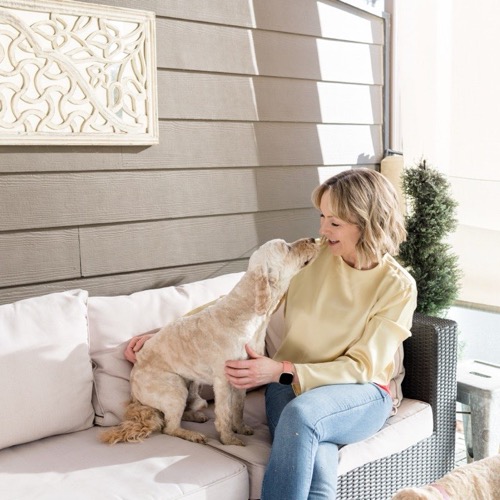
The Truth about Whether Your Anxiety Caused Your Dog's Anxiety
Show Notes
Anxious people create anxiety in their dogs, don’t they? Perhaps you’ve been told that. Perhaps you’ve thought that. It seems so plausible that it must be true, right? Well, not so fast. There isn’t a ton of evidence, especially as it relates to separation anxiety. That’s why in this podcast I debunk this theory, and explain why it’s unhelpful, limited thinking. Tune in to find out more.
Transcript
Download SRTHello, and welcome to the Be Right Back Separation Anxiety Podcast.
Hi, I'm Julie Naismith, dog trainer, author, and full-on separation anxiety geek.
I've helped thousands of dogs overcome separation anxiety with my books, my online programs,
my trainer certification, and my Separation Anxiety Training App.
And this podcast is all about sharing my tips and tricks
to help you teach your dog how to be happy at home alone too.
This week in my Separation Anxiety Heroes membership group,
the topic of whether anxious people, anxious dog parents,
cause their dogs to be anxious came up again.
And I say again because it comes up a lot.
And my heart always, always sinks when I hear the question.
I just hate this premise so much.
Now, to be clear, there are definitely studies, research studies out there,
which have tried to get to the bottom of this.
There are studies that look at, are there any traits in humans that relate to anxiety
that seem to then link to having a dog who might be, say, aggressive or have home alone issues.
And yeah, there are some studies out there that kind of maybe suggest, hint at,
I'm going to say hint at, that there is some link between human anxiety and dog anxiety.
But it's by no means concrete. It really isn't conclusive.
And it's founded on research which, yeah, some of it's great and some of it isn't so good.
And putting all that aside, even if there were conclusive evidence,
I would still be really, really frustrated at this topic.
Now, I'm not going to go into these studies in any detail, but I know that you love your research.
So I'm linking to an article in the show notes,
which gives a bit more information about the research that I'm talking about.
But here's the thing, and here's what I want to talk about today in this podcast.
And this is what I do say to my separation anxiety heroes clients over and over.
I don't care about these studies. I don't. Not one bit.
Now, if you followed me at all, if you read my books or followed anything that I do online,
you might be a bit surprised to hear me say, what do you mean you don't care about these studies?
Because you might have heard me say I'm all about the evidence. I'm all about the research.
So here I am now saying I don't care about these research studies.
So hang on a minute. What kind of evidence based trainer does that make me?
Well, it's a really good point and it's a valid challenge.
And in this episode, I want to explain to you where I'm coming from on that.
But the headline is I really have no use for research that isn't helping dog parents to help their dogs.
It's really important, I think, in the canine world that research is purposeful,
that research is helping to solve a problem.
And it doesn't always because researchers can choose to research topics that they find interesting.
And heck, what an interesting topic, right? Anxiety, human anxiety, anxious people cause anxious dogs.
I mean, it's a fascinating topic. So I'm not surprised that it gets researched as much as it does.
And I would be OK with it being researched if I then felt any of the conclusions.
Again, I'm going to say a big if even if even if we decided, look, it's all about you and it's all about your anxiety.
And it isn't. It isn't. OK, but even if let's just pretend that that research says it's all about you.
That's still not helping you. So let me talk through why I'm really,
really done with this obsession and why I think we need to stop the search.
Stop trying to find blame. Stop trying to find out why you might be causing your dog to be anxious.
Here's why I see absolutely no value. Reason number one.
What do we mean by an anxious human? We always say we struggle to define exactly what an anxious dog is.
And humans are like dogs, but even more complex.
So defining what an anxious person is, is like on another level hard compared to defining what an anxious dog is.
If we struggle to define anxiety in canines, how can we really be precise about defining an anxious dog?
And the challenge back would be, yes, Julie, but there are tools that have been used for decades that assess people's personalities,
that assess their traits. And I get that and I understand.
And I also know about them because before I worked in the world of dogs, I worked in a corporate world
and I worked in a people management role, a people coaching role.
So I do know these tools exist. And many people swear by these personality profiling tools.
And sorry, side note, when you look at the research studies that investigate this kind of anxiety
and people to anxiety and dogs link, you'll see that most of them are underpinned by personality profiling tools,
different ones. The most common one that you'll see in these research studies is what's called the big five,
the big five personality test. And the idea is that the people in the studies,
the pet parents in the studies would be profiled using something like the big five.
And then the results from that would be assessed against whether their dogs would have anxiety.
So that's kind of how most of those research studies work. But those tools aren't perfect.
And in fact, when you dive into how those tools are tested, I'm talking about the personality test here.
When you dive into how those tools are checked for credibility,
you find out that they're actually prone to bias.
And in particular, they are prone to showing bias against anyone who isn't white and who isn't male.
I know. What a shock. It's all about white males. I know. Who'd have thought that?
So those studies, even if they did show something conclusive, for me, have a really flawed premise.
Oh, and yeah, they are definitely biased against anybody who comes from one of the countries that represent the global majority.
So outside of, you know, the UK or the US, they are even more flawed.
All right. So we've got a flawed basis. Then number two, reason number two.
I keep saying if because if you take away from this podcast that Julie is saying to you that your anxiety causes your dog's anxiety,
then I have failed. So reason number two, if, if we assume that your anxiety is contributing, but I say it's a big if,
what are you going to do about it? I mean, are you going to just say, OK, you know what I'm going to do?
I'm going to switch off my anxiety, flick a switch. And then when I do that,
I know my dog is going to be immediately happier and less anxious because these studies tell me that that's what's going on.
Now, if you're listening to this and you struggle with anxiety in your life,
you'll know how ridiculous it is to think of anxiety as a choice.
It's not something that anybody decides for themselves.
We do have a choice about how we can tackle things like anxiety.
Of course we do. But we don't have a choice about whether we have it or not.
And however, I do think some people think that conditions like anxiety are a choice.
You just need to, you know, get a grip and stop feeling that way and stop reacting like that.
But, you know, if you've got anxiety, you know, it's not a choice.
And so if it's not something we choose, how can we choose to change our anxiety to change how our dogs feel?
Switching our anxiety on and off is not a dog training technique.
So that's the second reason why I'm really fed up with all of these studies
and the premise that you're causing your dog separation anxiety.
Reason number three.
So if we assume that anxiety doesn't turn on and off like a tap, then we all assume that one, right?
We can all agree that anxiety doesn't just get flicked off with a switch.
Then I'm willing to bet that there's a really good chance that at some point in your life,
if you have anxiety, you've either tried to work on it or thoughts about working on it.
So if you read an article online or listen to a podcast or see a comment in social media
that links to research suggesting that your anxiety is causing your dog stress,
you're not suddenly going to go, oh my goodness, what a light bulb moment.
Maybe, maybe it's a really good idea if I work on my anxiety.
Oh, thank goodness somebody told me.
I mean, tell me, have you really not thought about addressing your anxiety?
Of course you have.
Of course you have.
And anybody outside of your world who is, I don't know, unsympathetic enough
to not realize that you get this, you're aware of this, you're aware of what goes on for you.
So a research study that says, oh, wait a minute, all people have to do is not be anxious.
How is that helping?
Most people who are living with anxiety are doing their best to live with it.
Whether that's just dealing with everyday life despite anxiety,
whether it's overcoming it or doing whatever they can.
No one needs an article about dog behavior to give them a light bulb moment about their anxiety.
Reason number four.
Okay, so you learn, you've been told that you're actually causing your dog anxiety because of how anxious you are.
How is that going to make you feel?
Feel better?
No, of course you're not going to feel better.
You're going to feel more anxious.
You're going to feel more worried.
And that's not helping you.
It's not helping you and it's not helping your dog.
So, yeah.
Reason number five.
Now, not only are you feeling more anxious because you've got this extra burden,
but you're going to feel guilty too, aren't you?
Yeah.
And the thing about guilt is there is a lot of research on this and it's really good research.
And the research says that guilt is a barrier to taking action because guilt is such a negative emotion.
It weighs us down.
It really impedes us from being able to think ahead.
Because guilt, when you reflect on it, guilt is backward looking.
Guilt is all about what I should have done, what I didn't do, what I did do.
It's very backward looking.
It's not about the future.
And when you get mired in too much guilt, when you get dragged down by too much guilt,
it's very hard to look positively about your next step.
So, feeling guilty that you may or may not have caused your dog's anxiety is just going to keep you feeling more stuck.
And reason number six is my final reason.
This is a biggie.
Anxious people equals anxious pets.
That assertion plays right into this whole strong leader dominance rubbish.
And we know that that has absolutely no part to play in modern dog training.
And that kind of links back to my first reason about my concerns about the bias in research that, you know,
labels us as anxious or labels us as one of the great labels in one of these personality tests is neurotic.
Because women often do worse on these tests.
Women certainly do worse on these tests when it comes to being perceived as being aggressive.
And so, to me, a lot of this plays right into the hands of people who say,
if you're a strong leader, and typically what people mean by that, they mean that you're a male,
you're being macho, you're being kind of a brute.
If you're like that, your dog has no problems.
So, all the TikTokers who are all about leadership and dominance and it's just how you show your dog who's boss,
this kind of premise that anxious people make anxious dogs, oh my goodness,
it's just, that is just golden for them to take advantage of.
So, okay, can you tell I'm on my soapbox again today?
You know, if you've listened to my podcast, you know I do soapbox stuff.
But because I care so passionately about you and about your dog,
and I just wish that precious research money could be spent on a topic that would actually help people with anxious dogs,
that would help us get our dogs over their anxiety rather than making us feel extra guilty or worried about our dog's condition.
And don't get me wrong, there is an amazing amount of fabulous research out there.
And also, I don't blame anybody really for doing research into a topic that's as fascinating as this,
because I tell you what, it gets a lot of clicks.
So, if you want to get your name out there, you want to get a study published,
and if you want to get articles written about it, what a great topic to pick.
But that's not why we should be doing research.
We should be looking to research that's going to help solve a problem for people and their pets.
All right, I'm done.
And the too long, didn't read version of all of this is,
it is not your fault. Your anxiety did not cause your dog's anxiety.
Okay, I'll catch you on the next one. Bye for now.
Thank you so much for listening to this episode of the Be Right Back Separation Anxiety Podcast.
If you want to find out more about how I can help you further, head over to julienaysmith.com.
Meanwhile, if you enjoyed listening today, I would love it if you would head over to wherever you listen to your podcasts
and consider rating my show.
Thanks so much, good luck with that training, and bye for now.
Be Right Back
Need help with separation anxiety?
Join the Be Right Back program and get the support you need.
Start helping your dog today