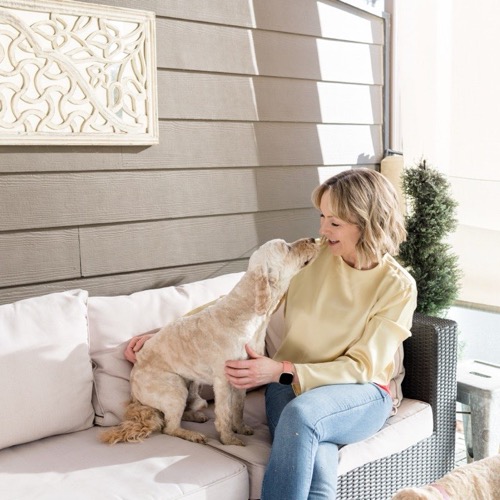
Beyond Obedience: Teaching Your Dog How to Feel Safe in a Daunting World
Show Notes
Join me in the latest episode of “Be Right Back! Separation Anxiety Podcast”, where I explain the single most important lesson we can teach our dogs: that they are safe. In the episode, we also look at how to keep dogs safe, and why must prioritize our dog’s emotional well-being above all else. We’ll explore why the use of unethical, aversive training tools exploits a dog’s need to be safe, and dissect why these tools can be so damaging. We’ll also dive into how understanding dog body language is crucial in identifying dogs’ discomfort or fear. If you’re keen on creating a secure and fear-free world for your dog (and I know you are), this episode is a must-listen! Got a dog who’s scared of being alone? I can help! Check out my free guide.
Transcript
Download SRTWhat's the number one thing that we need to teach our dogs?
You might be thinking, it's recall, it's definitely recall, I need my dog to come away from squirrels.
You might be thinking, no, actually, it's walking nicely alongside me on their leash.
Maybe it's, I need my dog to sit when I've got company.
But I don't think it's any of those things.
I passionately believe that the number one thing we need to teach our dogs is how to feel safe.
And that's why in this episode, I'm exploring how we can help our dogs feel safe and cope
with the crazy, crazy human world, crazy to them, that we expect them to be okay with.
Hello, and welcome to the Be Right Back Separation Anxiety Podcast.
Hi, I'm Julie Naismith, dog trainer, author, and full on separation anxiety geek.
I've helped thousands of dogs overcome separation anxiety with my book, my online programs,
my trainer certification, and my separation anxiety training app.
And this podcast is all about sharing my tips and tricks to help you teach your dog how to be happy at home alone, too.
What's the most important thing you can teach your dog?
Well, I've been thinking about this a lot.
As a trainer, you wouldn't be surprised that I think an awful lot about what matters in terms of what we teach dogs.
But my perspective on this has definitely changed over the years.
And I truly believe now, I've come to the conclusion that the number one thing that we can teach any dog is teaching them that they're safe.
Because we owe it to dogs.
Feeling unsafe, feeling threatened, feeling scared is a horrible way to be.
And unfortunately, the human world is a scary and threatening place for dogs.
And if they can't feel safe, then instinctively, nothing else matters.
Because to a dog, not feeling safe means they're feeling like there's a threat to their survival.
And when they're under that constant threat, everything else becomes harder.
A dog who's always worried and scared about life can't bond with us.
They find it harder to do that, certainly.
And scared dogs who feel unsafe, who feel threatened, find it harder to learn.
And we know as well about the ongoing risk of stress that never goes away.
And when you feel unsafe, when you feel like you're constantly under threat, you're always stressed.
And that constant stress leads to physical issues, too.
So it's not just something about an emotional state.
Feeling unsafe and feeling in a constant state of threat has physical implications, too.
Actually, not just for dogs, but for us, too.
And I just think that for too long, we've focused on obedience.
I mean, that's what dog training used to be all about.
Like, it was just that. It was just obedience.
Isn't that a horrible world as well? I think it is.
I don't think we want dogs to be obedient. I don't want my dogs to be obedient.
Certainly not in the classic concept of, you know, do what I tell you when I tell you.
Because servant, master, I'm in control.
You need to submit to whatever I request. Because you're a dog, right?
And for too long, that's been the model of our relationship with dogs.
Do what I tell you. Don't ask why. There's nothing in it for you.
And that whole classic thing as well about that dogs should want to please.
You know, dogs don't do anything, shouldn't require anything to do what's right,
because they should just do it because they want to please us.
Which is a ridiculous model because no animal, and that includes us,
expends labour and does difficult things, or even easy things, without expecting something in it for them.
You know, I don't go to work to please my boss.
Well, I guess I'm my own boss now, but back in the day, I didn't go to work to please my boss.
That might have been part of it, but I went to work because I had bills to pay.
But this whole model of wanting to please, dogs being, you know, we want dogs to be compliant,
we need them to be obedient, is all about us.
And it's nothing about them and their needs.
Now, things have evolved a bit and we do talk a bit less about obedience,
although obedience is still something that most people who have dogs do expect of their dogs.
But maybe now we talk about the more euphemistic life skills.
So it's not that we want dogs to obey us.
It's just that we want them to do things that we require.
And kind of, well, it's the same thing, really, in terms of life skills.
So we want them to sit when they greet visitors.
We want them to come back from the squirrel when we require them to.
And we call these things life skills.
But they're still requiring dogs to do things that typically don't make sense to dogs.
I mean, actually, that's obedience in a nutshell.
It's taking a dog with natural instincts, with natural, normal dog behaviours,
and moulding that dog to our needs.
Which in a way is, not just in a way, in a big way, is really hard on the dog.
You know, we decided that we would domesticate dogs.
30,000 years ago, dogs started wandering up to camps and taking part in the human life.
And we thought, oh, this is great. There's some benefits for us here.
So we decided to domesticate dogs.
But domestication has meant you have to fit into my world.
You have to be the one who moulds. You have to be the one that changes.
And if you think about it, dogs live a really unnatural and abnormal life.
They are imprisoned.
They are not in control of their own schedule.
I mean, maybe to a degree they can ask to go out to the loo.
They can tell us when they're hungry, but we're still dictating most of that.
We work on house training so that dogs can hold it for as long as we need them to,
so that we can take them out when it's convenient for us.
So we require dogs to fit into our world without ever thinking how difficult,
or confusing, or complex that might be for them.
And a dog's life is all about doing stuff that makes perfect sense to them
because it's natural dogginess.
They do normal, natural dog behaviours that totally add up to them,
but which are completely problematic for us.
So normal dog behaviours that dogs don't even question very often are problems to us.
So they break our rules without knowing our rules.
And those rules don't make any sense to them.
It's just that we don't like how dogs behave,
despite the fact that we've been inviting them into our homes and into our lives for 30,000 years.
But they have to fit our rules.
And how confusing, how confusing when you don't know the rules,
nobody's telling you the rules,
and when your behaviour makes total sense to you,
but for whatever reason, the person, the being in control,
because remember, we are totally in control,
is saying, no, that behaviour isn't okay.
Like, what? Imagine being a dog. Imagine how confusing it is being a dog.
Now, I'm not saying that that means that when we have a dog in our home,
we can just let them do everything that comes natural to them,
comes naturally to them, because of course,
part of domestication, part of the deal is that they can't chew the furniture.
A big part of the deal is that they can't go around barking who are on Zoom calls,
because maybe we're okay with that,
but most of the people on the Zoom call aren't going to be okay with that.
And we definitely don't want dogs bowling over granny when she comes to visit.
Granny's frail, Tiny's 50 kilograms,
and we don't want him jumping up and bowling over granny when she comes over.
So it does make sense to ask dogs not to do some things.
It makes sense to us, by the way, because if Tiny loves granny,
Tiny just wants to get close to granny and doesn't realise that bowling her over isn't a good idea.
It's perfectly natural to Tiny.
But can you see how all of these things that we're doing to mould dogs,
to change them, to stop behaviours that are unwanted, to make them fit into our world,
are all about what we want.
They're not actually about what dogs want or what they need.
And all too often, when we're focused on obedience,
when we're focused on changing behaviours to fit into what we need,
we're forgetting about how the dog feels, we're forgetting about emotions.
And as an animal, being safe matters more than anything else.
Because if you're not safe, then you are, by definition, feeling threatened.
And when you're an animal and you feel threatened, it's basic stuff, it's survival.
And so while we're thinking about changing our dogs to sit quicker,
come back from the squirrels more promptly and walk nicer on leash,
are we ever thinking about, does my dog feel safe?
Do they feel like the world is a place where they feel okay and they are not constantly under threat?
And I don't think we do.
And if we're not doing that, we're not taking care of their number one need.
Yes, we've got to feed them. Yes, we've got to give them water.
Yes, I get that. Yes, they need exercise.
But wrapped around all of that, they have a basic need to feel okay.
And I think that's what we should be spending more time on
when we think about how we interact with our dogs, what we teach them,
and what we quote, inverted commas, train them.
So what can we do then? How can we make dogs feel safe?
Well, here are five things that if we all look to do with our dogs, we would change their world.
You might already be doing some of these.
In fact, if you're listening to a podcast that's typically about separation anxiety,
I'm guessing that you already are prioritizing your dog's emotional well-being and their sense of safety.
So thank you for that. But let's have a look at the five.
And you see, are you doing all five of them? Are you doing none of them?
Maybe if you're not doing any of them, this could be a time to start.
So the first thing, number one, in order to make dogs feel safe,
this is quite an obvious one, but we need to keep them away from things that scare them,
things that hurt them or things that intimidate them.
So we need to cocoon them. We need to be making decisions for them
because frankly, we make most decisions for dogs in their lives,
but keeps them away from things that scare them.
So if we know that dogs don't like small children,
because small children running at them is just freakish,
then let's consider how we manage that for our dog.
Let's not take them to parks where there's going to be lots of toddlers running around.
It's not good for the dog that doesn't like toddlers and it's not good for the toddler either.
If our dogs don't like thunderstorms or if they don't like fireworks,
what can we do in our home to make a safe space for them?
And that's not putting them in a crate and locking the crate, by the way.
That's thinking about, do they need a dark space?
Do they need a quiet space? How can I create that for them?
So we really owe it to dogs to understand what they like
and what they are really uncomfortable with, what scares them, what hurts them,
and then think about how we can protect them from those.
All too often, though, we miss the signs that our dogs aren't okay.
So part and parcel of keeping a dog safe is really getting to understand a dog's body language.
One thing that makes me, I don't know, angry, emotional, want to cry, want to scream,
is when I look at some videos online, and I try not to look at many videos from trainers
who use cruel and harsh methods with dogs because it's unbearable.
But when I see those videos, I see dogs who are screaming,
screaming out that they are unsafe, that they feel scared.
But you won't hear them whimper, and you won't hear them cry, and you won't hear them bark or growl.
But their body language screams threatened, their body language screams scared.
And I just, I don't know whether these trainers don't know that these dogs are scared
because of the intimidatory methods they're using, or whether they just choose to ignore the body language.
And I don't know which is worse.
But we need to really, really get good at spotting the language of dogs and the way they tell us that they're not okay.
Because if we don't do that, and if we don't understand what they're telling us,
we can't keep them away from the things that do scare them.
OK, number two, in order to help them feel safe, we definitely need to make their health a priority.
Dogs who feel unwell, dogs who are in pain, dogs who are struggling with skin conditions,
or anything that makes them feel physically just out of sorts.
That's a threat to a dog. That's a threat to any animal.
Because a physical problem, that's life or death.
There's a big reason why, if you try and pick your dog's paw up, most dogs don't love paw restraint.
I'm not talking about a dog with a painful paw, but just any dog.
Most dogs don't like their paws being restrained. They have to learn to like it.
Well, they don't have to. We have to help them to be okay with it,
because we do have to end up clipping nails or dremeling nails.
But the reason I'm raising this is because to any animal, bodily injury is a huge, huge threat.
And for dogs or any animal that roams around, an injury to a limb could be terminal.
If you can't run and chase prey, if you can't run away from predators,
because you've damaged your paw, you've damaged your limb, then your chances of survival are low.
And so instinctively, dogs withdraw when we try and hold a paw,
particularly dogs who haven't been taught that paw holding is okay, because it's not normal.
It's really unnatural and it's threatening.
So coming back to why it matters that we make health a priority is because we want dogs to feel physically okay
so that they don't feel threatened by pain, by something that makes them worry that,
okay, I am now not as fit as I could be. I can't chase my prey down. I can't run away from a predator.
Obviously, dogs aren't chasing prey. Well, they're chasing squirrels or chasing rabbits, but they don't have to do that to eat.
But that wiring hasn't gone away from our dogs' brains.
That's why dogs hide pain so well, because they don't want to be seen to be weak.
So making their health a priority, making them feel that they are up to whatever challenge the world throws at them,
physically, really, really matters.
And number three, when they are scared of things, when they do feel unsafe,
and when we've identified the cause of that worry and the cause of that lack of safety,
then we owe it to them to help them overcome their fear, to help them overcome the things that scare them in the world.
So we don't just keep them away from those things, and that really matters.
And sometimes that's all we do. So sometimes with things that dogs are really, really scared of,
that might be all that we do. We keep them away from the thing that scares them.
But unfortunately, because dogs live in our crazy world, we can't always keep them away from the thing that scares them.
Take fireworks. Most people with a dog who is frightened of fireworks,
most people who have those dogs don't set off fireworks in their garden.
Some people do, but most others don't.
What we do is we try and create a space where our dogs can go when they feel threatened by fireworks,
but we also try to work on the fear that our dog has of fireworks,
so that they don't feel as threatened whenever they hear the fireworks going off.
So it's combining keeping them away from the things that scare them as much as we can,
and then where we can't control that, where we've got things, where we've got stuff that we know our dog is going to be exposed to,
to help them feel safe, we owe it to them to teach them that these things aren't as scary.
So from my perspective, coming at this with my separation anxiety hat on,
yes, for some people what they end up doing is they end up never leaving their dog.
Often that's because they embark on training and it becomes a bit too much,
and they've already gotten into a really good habit with managing absences,
and so they just go, no, do you know what, we'll just stick with this, it's fine, it's working, it's fine.
But the vast majority of people can't do that.
The vast majority of people can't indefinitely find a way for somebody always to be with their dog.
They have to work on getting their dog to be okay with being alone,
because it's not a long-term solution to always have somebody with their dog.
And just like the threat of bodily injury being huge, huge in a dog's world,
because, as I said, bodily injury can often mean survival is at risk,
another massive instinctive threat is being separated from the rest of your family.
Because dogs in the wild, animals in the wild, depending on the species,
but for lots of animals, being in a group matters.
And for dogs, it's quite normal for them to hang out with other dogs.
It's not as formal as we used to think it was, but dogs do seem to form some loose associations.
And so then what happens is we decide that they're going to come and live with us,
and we're going to separate them from everything they've ever known,
any human they've ever known, any other animal they've ever known,
and we expect them to be okay with that.
Well, naturally, that's quite threatening.
And we actually get really lucky that about 80% of dogs don't have a problem with that
or quickly get accustomed to it.
But 20% of dogs also really find it hard.
And it isn't a surprise.
To me, the surprise is always how many dogs actually just get on with it.
So I come from a point of view of, yes, let's keep dogs away from scary alone time.
And as much as it's abnormal for dogs to be totally isolated, let's help them deal with that abnormality.
Let's help them deal with that crazy aspect of human life that means dogs will be alone.
It's not cruel to do that.
What's cruel is to ignore dogs who can't cope on their own.
And if a dog can't cope on their own, giving them those coping skills,
that's what's going to help make them feel safe when their person goes out.
So it's that combination of keeping them away from the thing that scares them
and then gradually giving them the skills to deal with whatever it is they find so threatening.
Number four.
My fourth big reason or fourth big way in which we can help dogs feel safe is give them choice.
Give them choice. We must give dogs some choice.
We must listen to dogs.
We don't do this anywhere near often enough.
Going back to those YouTube videos,
I was watching a video which was called how to desensitize a dog to nail clipping.
And I think it even said something like humanely or kindly, something like that.
But it was anything but.
This poor dog was being forced, forced through a nail clipping process.
The trainer was restraining the dog's paw and she was saying things like,
I'm going to keep hold of his paw because if he pulls back,
then he's going to learn that he can pull back.
I'm like, yeah, right.
So he should be learning that it's OK to withdraw your paw when you're having a nail trim done,
if you don't like it.
She was also doing things like a collar grab.
So she was holding the dog's collar.
So that dog had no choice but to go through this process.
And what was so sad was that this dog was obviously distressed.
There were so many things, so many obvious signs of distress in this dog.
Loads of lip licking and repeated yawning and ears pinned back, big whale eyes.
The dog was constantly licking the trainer's hand.
It was horrible to watch.
It's horrible to see the dog in that state.
And it was double distressing to hear the trainer say that this dog was OK
and that this was a kind method for working with this dog.
Just, I don't know.
I think if you are, and this is to all the dog professionals out there now,
if you are taking money from clients and you can't see a dog who feels unsafe,
who feels threatened, then you need to stop.
I mean, I don't just mean stop working with that dog.
You shouldn't be taking money from people.
It's a fundamental, it's the most fundamental skill that we as dog professionals should have.
We should be able to read dogs because they are telling us loud and loud,
loud and clear when they're not comfortable.
And if we cannot spot that, we either need to brush up our skills very quickly
or we shouldn't be doing this.
All right, you can tell this one's a biggie for me.
So give them choice.
They tell us, they speak to us loud and clear.
When they are not comfortable, they let us know.
We need to listen to them.
OK, finally, we need to use training methods that are kind and ethical when we train.
Why?
Because if we don't, then we are forcing dogs through the training process.
So just going back to that example of the dog who was having its nails trimmed,
there was no choice in that.
The dog did not feel safe.
The training method wasn't kind and ethical.
And apart from the fact that in that moment, that dog would be having a terrible, terrible time,
it's a really flawed process because dogs who hate things but are forced to go through them
usually end up getting more scared.
So not only is it unethical and unkind to deal with dogs in this way, to use harsh methods,
we are just creating more problems than we're even ever solving.
The whole thing about using aversives in training,
by aversives, typically we mean things like shot collars, prong collars, citronella collars,
shape cans, harsh words or belly bands or those leashes that wrap around dogs' bellies.
Anything that causes discomfort, fear, pain, disgust for a dog, that's an aversive tool.
And aversive tools are actually all about making dogs feel unsafe.
So they're the opposite of what we need for dogs, what we need to do for dogs.
If a dog feels threatened by an aversive tool, because dogs are all about trying to stay safe,
if they feel like they're in pain or if they feel like the last time that tool was used
it was scary and horrible because they were in pain, they still feel unsafe.
So if it's a shot collar, even if that shot collar is not buzzing,
dogs remember the last time that shot collar went off and they felt threatened.
So having that shot collar on them or having the threat of that shot collar,
that's still making them feel unsafe. In fact, that's how these devices work.
They work by making dogs feel threatened, by making their world unsafe.
And because dogs want to change that, they say, well, what is it?
What's making this happen? What's making that pain in my neck or the threat of the pain in my neck?
What's making that happen to me? What can I change? What can I do differently?
Nobody's telling them, by the way, communication around the use of aversives isn't black and white.
Here you go. You did this one thing wrong. For most dogs, it's a guessing game
because it could be anything that happened to them at the time that aversive was used.
So not only are they threatened and feeling unsafe, they're a confused dog as well.
So these aversive tools actually prey on dogs need to feel safe.
The way that dogs develop fear is that they can develop fear in one situation,
say when an aversive tool is used, and that can spread.
So, you know, if a dog is jumping up at someone and a shot collar is used,
I once visited a very well-known sanctuary, a massive sanctuary in the US,
and somebody there was visiting and they were waiting outside and they had their dog with them
that they'd adopted from this sanctuary. And this dog came to jump up at me.
Now, I always try to go down to dogs because I know that dogs like to often jump up to greet.
And because too often dogs get punished for jumping up.
So I try to head it off and meet a dog at its level.
Then the dog doesn't get into trouble and the dog gets some reward for having four feet on the floor.
But this dog was too late. This dog was already jumping up at me and I heard that.
Oh, that just makes my stomach turn. Just makes me feel so sick to my stomach.
When I hear that dog was getting a shot collar activated because it was trying to jump up at me.
Now, the problem there is that many dogs start to dread the shot collar going off.
And so they're trying to work out what made the shot collar go off.
And dogs can start to associate the shot collar with whatever's around them.
So it could be totally possible that that dog starts to associate the shot collar with people.
With people. So that instead of being happy to see people, they start to be worried about seeing people.
And by the way, if you have a dog who loves to jump up at people,
that is what dog trainers often describe as a nice problem to have.
Now, we don't want your dog, like I said, jumping up and knocking over granny when she comes around for Sunday lunch.
But it's better to have that problem than to have a dog who feels really unsafe around people,
then approach people, hides in a corner, keeps themselves quiet until that moment when they snap.
So let's continue to keep taking aversives off the table.
More and more countries in the world are coming to the conclusion that we shouldn't be using certain tools with dogs.
And the more countries that pass legislation and the more countries that outlaw more tools,
the better the world is going to be for dogs and for people with dogs too.
So let's not use aversive methods that are fundamentally about making dogs feel unsafe.
Let's use kind, ethical methods instead.
All right, so you can tell that I feel really passionate about keeping dogs safe.
I do think it's the way we need to evolve how we work with dogs and how we try to change their behavior
instead of always requiring them to fit into our crazy world.
Let's first and foremost think, but how can I make you feel safe?
And that way, everything else opens up and everything else becomes possible.
But until dogs feel safe, nothing else matters anywhere near as much.
All right, that's it from me for this podcast. Thank you so much for listening.
I know you've got plenty of listening choices, so I appreciate you taking the time to tune in today.
I will look forward to seeing you on the next one. Bye for now.
Thank you so much for listening to this episode of the Be Right Back Separation Anxiety Podcast.
If you want to find out more about how I can help you further, head over to julienasmith.com.
Meanwhile, if you enjoyed listening today, I would love it if you would head over
to wherever you listen to your podcasts and consider rating my show.
Thanks so much. Good luck with that training and bye for now.
Be right back.
Need help with separation anxiety?
Join the Be Right Back program and get the support you need.
Start helping your dog today