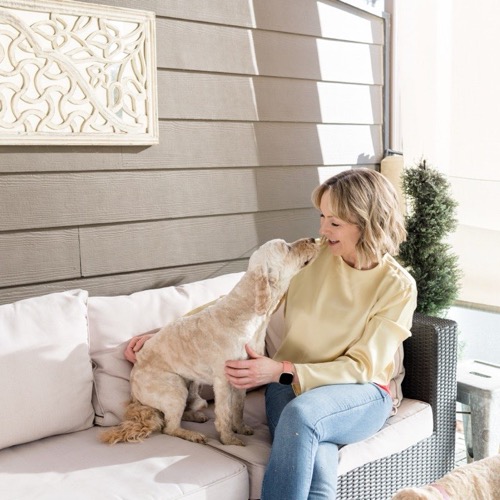
Sophie the Romanian Rescue—Helping a Dog Who's Scared of the World with Simon Wooler
Show Notes
In this episode, we’re not talking about separation anxiety. Instead we’re looking at how to help a dog with different fears.
Tune in to hear my interview with Simon Wooler. Simon has been working with Sophie the Romanian Rescue and her family, Rory Cellan-Jones and Diane Coyle.
It’s a wonderful, heartwarming story. Not only will you love Sophie and her humans, you’ll love Simon’s adivce for anyone working with a fearful dog. ***
About Simon Wooler
Simon is a qualified trainer, certified by the Academy for Dog Trainers, one of the most rigorous dog behaviour and training programmes in the world.
He has been training dogs for the past twelve years, specialising in fear and aggression. He has worked as a volunteer trainer for Black Retriever Cross Rescue in Wiltshire.
His goal is always to help owners feel confident, in control and enjoy training their dogs because when it comes to success, having fun through the process is part of delivering a great result.
Simon came to dog training after 20 years as a sound engineer so loud barking hardly registers on his personal decibel scale. His own troubled dog, Thomson, was the motivator for seeking out effective, evidence-based training methods.
If you would like Si’s help with your fearful dog, his website is sociabledog.com. You can also find Simon on Twitter, where he’s shared updates on Sophie. And of course you can follow Sophie’s adventures on Rory Cellan-Jones’ Twitter account. Meanwhile, back to separation anxiety. :) If you have a dog with separation anxiety you can download my free guide here.
Transcript
Download SRTWhat happens when you adopt a dog, a dog who you fully expect to bring joy and light and
connection to your family and to your life?
Because that's why we love dogs so much, right?
But only to find out that the dog you've adopted is so frightened of the world that all she
can do is hide behind your sofa.
Well in this episode, in a departure from talking about separation anxiety, we're going
to be talking about a dog just like that and you might have heard of her, she's quite
the Twitter star.
Her name is Sophie, she's a Romanian rescue and she lives with Rory Keflin-Jones and Diane
Coyle.
And I'm really excited because I'm getting to speak today to Simon Wooller and Simon
is the trainer who's been working with Rory and Diane and Sophie on building Sophie's
confidence on helping Sophie be less frightened of the world.
Si is a fellow Academy for Dog Trainers trainer, he's been working with dogs for 12 years specialising
in fear and aggression so he has a lot to say about fearful dogs.
And his goal with any dog and with Sophie is to help people, help guardians and owners
feel confident and in control and enjoy the training and enjoy their dogs.
He's got a wonderful story to tell about Sophie, so whether you've got a dog who's frightened
of the world or frightened of people or frightened of anything, I think you're absolutely going
to love what Si has to say today.
So tune in to find out more.
Hello and welcome to the Be Right Back Separation Anxiety Podcast.
Hi, I'm Julie Naismith, dog trainer, author and full-on separation anxiety geek.
I've helped thousands of dogs overcome separation anxiety with my books, my online programmes,
my trainer certification and my Separation Anxiety Training App.
And this podcast is all about sharing my tips and tricks to help you teach your dog how
to be happy at home alone too.
So, Si, thank you so much for your time today.
So we're talking about Sophie.
Now, Sophie's story could be very familiar to lots of people in the UK, but for listeners
around the world, can you tell us a bit about Sophie's backstory?
Yes, I can tell you the backstory of Sophie.
She was found in the street in Romania as a very young pup and she was fostered, as
we understand it, by a vet whose brother took her and kept her at his farm.
And she was homed with some other dogs and kept in the barn.
To all intents and purposes, well looked after.
We suspect that not particularly socialised in that period.
So she kind of imprinted on the people that were at the house and the dogs that were resident
there.
But she didn't get a lot of contact, as far as we can tell, with unfamiliar people and
unfamiliar dogs.
And so consequently, when she arrived in the UK, she came into the house, she had to be
carried into the house of Rory and Diane, and she promptly hurtled behind the sofa.
And that's where she stayed for several days.
Oh, wow.
So Rory and Diane, her new family in the UK?
Yes.
Rory Kethlen-Jones is the former technology correspondent for the BBC.
And Diane Coyle is probably one of the most phenomenally intelligent people I've ever
met.
She's a Cambridge professor of economics and a former chair of the BBC, or at least the
temporary chair of the BBC.
Oh, wow.
Wow.
And all manner of other things, frankly, author, as is Rory.
So she's landed in an intelligent home, a clever home.
They didn't know they were getting, they presumably thought they were getting this adorable dog
who would just be, you know, maybe have some settling in issues, but they weren't given
any heads up that they were in for quite a challenge with her, right?
No, they weren't.
But in fairness, I think, like many people would do, the benchmark was how she was in
Romania.
And that was, to all intents and purposes, friendly and excitable and interested in playful.
And that didn't translate to going into a very unfamiliar environment with unfamiliar
people after a three-day van ride, you know.
So that, those we heard you talking about, the sociability and so on, that was what she
was demonstrating in that family in Romania.
So there was...
Yeah, to a very small circle of people, you know, so ultimately, I think that one of the,
You know, the interesting thing about being involved in Sophie, with Sophie, is that you
see, you get an insight into what people think about dog behaviour and what they think about
how to fix issues around dog behaviour.
So the general kind of thing that people would normally be getting from their family and
friend circle, if you're working with somebody with a dog like Sophie, and the stuff that
you wouldn't normally see.
So you don't know that that input is happening.
So this has been a really insightful experience, because I can see that in real time.
I can see all of the good advice and suggestions that they get, and some of the less.
Because everybody's got an opinion, haven't they, when it comes to dogs?
Everybody's an expert.
Yeah, they have, because everybody's got one, and everybody's gone through an experience
of some sort with them, you know.
And that informs how they see others.
Yeah, yeah.
So Sophie, like you just described, she spends three days in a van and transport, and she
arrives in the UK.
Does she go straight to her new home, or is there a transition period?
Yes, 3am in the morning.
Oh, right.
Yeah, 3am in the morning was when the van landed, and that's when Rory went out and
got her.
But he literally had to carry her into the house.
And I think, in fairness, she had a brief sojourn into the garden, hid under the patio
table, and then headed straight back in behind the sofa.
Wow.
And so what did they make of that, of her doing that?
What did Rory and Diane do?
Well, I think they were bemused, like a lot of people would be, you know, and a little
bit lost as to how to confront it.
I think one of the things that, you see, what I did was, it's all Nina, my partner's fault,
because she was looking at the Twitter feed.
And Rory and Diane had had a dog that they loved very much called Cabbage, who Rory used
to tweet about a lot.
And she died a year ago, roughly a year ago.
And so they got Sophie with a mind that she would help Rory, because he is a very open
sufferer of Parkinson's disease.
And he does a lot of work in that regard.
But it's important for him to get exercise and all of that sort of thing.
So Sophie was his idea of a reason to get out and do some exercise.
And now this poor little dog was behind the sofa, you know.
And Nina commented to me that she thought there was a curious, curiously wide range
of suggestions coming from people that might be quite confusing.
And this is on Twitter, is it?
On Twitter, yeah.
So people are dying to Twitter, fixing.
Yeah.
Okay, got it.
Yeah.
And so I contacted Rory and Diane and said, you know, I gave them my credentials and I
said, if you need any advice, you know, get in touch.
I'm more than happy to have a chat, which they did about three and a half nanoseconds
later.
And from there on, I've been down there once, didn't see a lot of her, because that was
pretty early days.
So I wasn't really expecting to.
But we've communicated over Zoom, we've communicated over WhatsApp and Messenger and any kind of
platform that works for us under the circumstances.
And you know what?
Actually, you know, I'm probably pre-empting a question here from you, because you will
know as a separation anxiety expert, that actually platforms like Zoom and WhatsApp
and the like are incredibly useful in the work that we do with dogs, with particularly
dogs that have fear or anxiety related issues, because the level of contact that we can have
with people is huge.
And the inter-session contacts that we can have.
And I find that people use it.
If it's there and available and you just do a little nudge, they'll ask you a question
or they'll tell you about something that's happened in their day or their week.
Yeah.
And you can address it straight away, instead of those things building up between sessions
and then you've got only a limited time to deal with them.
So that's been an invaluable way of working.
I love it.
I love it.
And also, we're not then adding to the stress.
We're not an additional stressor.
We're not there.
We're not adding to the stress that a dog is comfortable with strangers.
So let's talk about that then.
So what were the biggest challenges that adorable little Sophie was facing?
You talked about the hiding, just not being comfortable around the new family.
What else was going on?
Well, I think...
That's pretty major anyway.
Yeah.
I mean, I would have to say, I think in essence, that's it.
Yeah.
That's the big sale item.
Yeah.
That everything is stressing her out.
At this point, everything is scaring her, right?
And the difficulty is that because we're human, we all want that to resolve quite quickly
because we want the story that we had in our heads to come true.
And I do that all the time.
I'm human.
I do that with stuff.
I even do that with dogs.
I've been sitting there willing Sophie to come out, just sitting at home, willing it.
But you know that it takes as long as it takes with fear cases.
And what you're doing is, a lot of the time, is that you're just trying to help the people
maintain a degree of calm about the process
and reassure them that it is going the way it's supposed to
because that feels like not much is happening.
Yeah.
Yeah.
And actually there is.
Yeah.
And, you know, some dogs come in from a rescue situation and they're not like Sophie at all.
They may have other issues.
They may have no issues, but they're not necessarily...
I mean, it's not uncommon for dogs to react the way Sophie did.
And so can you describe what that looks like?
Because if you've never had a dog who was like Sophie is,
if you've never had a dog shut down quite like Sophie did,
you probably don't know what that looks like.
Yes.
It looks like a dog that doesn't emerge very often,
finds a safe place where they feel confident that they are secure,
and then they don't actually emerge very much.
Right.
So, and that's the challenge.
And in many ways, and when they do, they're extremely cautious.
Right.
So there's a tendency for them to scan a lot, come out very slowly,
reverse very rapidly, you know, and it's a very slow process to get them out.
And one of those, that's one of the really big lessons,
one of the big messages that I would give people that find themselves with dogs like Sophie
is take it at their pace.
Any effort to coax them out or persuade them out
or change anything in the environment in order to try and accelerate that process
is only actually going to make the thing go slower.
Yes.
I think one of the interesting things about seeing what people are suggesting,
there's a tendency to think of it, because it's going slowly,
to think of it in terms of not working.
Yes.
And so what you see is very well-meaning suggestions on what you could do instead.
So, have you tried this? Have you tried that? Have you tried the other?
And that's working on a premise that there's a problem with the process that's taking place now.
But in fact, there isn't. It's doing what it's meant to do. It's working.
There is no need to change it.
Oh, I so agree with you.
And listeners who are used to tuning in to hear about separation anxiety will totally understand that.
Yes.
Because many of them are working through defensitization and gradual exposure.
It's a slow process. A lot of change happens without us even spotting it.
And meanwhile, everybody in their life is saying, well, that's not working.
So, why don't you try this? Why don't you try that?
So, I think it's comforting for people to know it doesn't just happen with dogs with separation anxiety.
It happens with a lot of these behaviors.
I just wanted to ask you about the hidey holes as well,
because they can all find different spaces.
I've heard of dogs hiding under beds or picking a particular room.
Did she have a spot that she was really entrenched in?
Oh, yes. She stepped on one sofa.
Right.
Behind one sofa.
Behind the sofa.
Behind it, yeah.
She only changed that when there was an event, an accident, a plate fell off the arm of the sofa.
Oh.
And she shut out and she picked another place for a short period of time, for a couple of days.
She picked another place.
But she went back.
Yeah.
She went back.
And I think that is a learning moment for people dealing with any kind of anxious dog,
which is that they do choose.
And actually, this whole thing is about choices.
Yes.
This whole thing is about giving dogs choices about what they do and when they do it.
And it's easy to imagine that she would be more comfortable in a crate or in a bed,
but she hasn't decided that.
She's chosen something other than that.
I mean, we decide that crates are for dogs,
but unless the dog accepts it, then that's a bit academic.
Yeah.
And so the golden rule for me, well, there are two golden rules, I think,
which is one, give the dog choice and respect that choice.
So everything you do is about looking to see whether they choose freely to do something or not.
And when they do, make sure that you make positive associations with you and their environment
and something that they already like.
But don't try and get them to move any further than they do.
And I think that's really hard.
People, when a dog starts to emerge and starts looking a little braver, to coin a phrase,
I mean, brave is funny.
Rory and Diane raised an eyebrow when I said this to them until I explained why.
I said, I don't want Sophie to be brave.
I want her to be fine.
Yes.
Yes, I agree.
I agree.
And there's a lot of people saying how brave she's being.
And I understand using the language sort of at home, oh, my brave girl and all that.
I get that.
You know, we all do that.
But actually what you want in desensitization and counter conditioning protocols
is for the dog to be fine before you move on.
Yeah.
Not having to be brave, not having to step just a little bit too far.
Yeah, not having to whiten up a lip.
Yeah.
Yeah.
And so what that looks like is she steps out and she stops.
And that's where you feed her.
Yeah.
That's where you make the association.
You don't try and get her to take one more step by throwing the food stool.
By hearing it.
You know.
And lo and behold, as she gets less fearful of the environment and of you, she gets closer.
And then she'll get closer in that way.
Because what we had to do with Sophie was we had to do it in kind of the reverse
to the way that you would ordinarily do a stranger danger protocol with a dog.
Not, you know, I mean, you know, you would normally be able to have a familiar human there
that the dog had a, you know, a safe association with.
And then you would introduce the stranger and the stranger would gradually get closer.
So I'm just going to stop you there, Sajid, because I just want to unpack that a little bit.
Because a lot of people won't be familiar with that.
So, but they will be familiar with separation anxiety training, which is we always start
with the easiest, easiest possible setup, whatever that looks like.
And then we gradually, gradually increase intensity as long as the dog's OK.
And as long as the dog's not telling us they're not comfortable.
And by the way, I love the thing about choice, because I'm often getting people say, well,
you know, the dog was barking and I was told not to come in because, you know, that's the
worst thing you can do.
Well, no, if your dog is telling you that they are so uncomfortable, they have to bark
to get you to come back in, come back in because you need to give the dog control in this process.
So I love the choice thing.
But yeah, you're right.
So we we start with easy and we gradually increase intensity.
And as you're saying, normally with a dog who's fearful around people, they usually
have people that they're OK with.
Usually the family is familiar people that you start with, but not with Sophie, right?
Right.
And that's going to be true for anybody who takes on a rescue, isn't it?
Yes.
But that's that's that's nervous about the situation that they find themselves in.
And so now you've got to recognize and respect the safe space and treat and look for the
signals from her about where where her boundaries are, where where her threshold is, where she
feels safe.
Yes.
And that's the place where you start to engage her with something that she really likes.
And in Sophie's case, it's cheese and bacon.
And you are using food.
So, you know, we don't use it for separation anxiety training.
But true.
As I often as I say to people all the time, you know, this is I'm a massive fan of using
food for changing emotions.
I mean, I've got one of those dogs that you and I were talking about that, you know, just
isn't comfortable with anything.
And I'm never without amazing stuff with him.
And so you and I, our response when a dog isn't isn't happy with something is, OK, let's
help it feel better with food, not coerce it into a behavior.
But let's change that association from I don't like this to, oh, actually, this predicts
something quite good.
So can you just tell us about that process of linking a previous thing with something
that's amazing?
Yes.
I mean, what you do is essentially you pair something they already think is good.
And usually it's something intrinsic.
I mean, you can you can absolutely use something that they've been conditioned to feel good
about.
But tea is a good starter.
Food is the easiest thing because, you know, it's the most potent thing and the thing that
they usually adopt.
Every dog has has its price, right?
Every dog has his or her price.
And so, you know, we probably don't want to get into the thing about my dog's not motivated
by food because every dog is right.
But anyway, so essentially what you do is it's Pavlovian.
It's a Pavlovian response you're looking for.
And in case anybody's not aware of the story of Pavlov's dogs, 19th century Russian scientist
Chappie with a big beard who lined dogs up in cages and they would ring a bell and two
seconds later food would be delivered to the dog.
And they would repeat that over and over and over again until the point at which the dog
was salivated at the sound of the bell because they knew that the bell meant food.
And so they were having an involuntary anticipatory response to the bell.
So now you know that you've created a positive emotional response to the sound of a bell
by pairing it with chicken, whatever it is.
And we know, by the way, in separation, I'm sorry, I keep bringing it up.
But we have the other way around.
So often keys or shoes or coats have a conditioned negative response.
Right.
Because they say something bad is about to happen.
So we see it to just just to give people some context.
That's what's going on.
Just what Simon described, but reversed with dogs who are frightened of being left.
So that thing can predict something good or something bad.
Right.
Yeah.
I mean, separation anxiety training is a really great example of how dogs can start to put
sequences together.
Right.
They really learn the sequence that leads up.
That's why people find it difficult to understand why a dog does something which apparently
has no, you know, out of the blue, spontaneous.
There was no reason for it.
There's always a reason for it.
It's just that they've learned the sequence all the way back to whatever it was, you know.
Yeah.
But in the case of dealing with non separation anxiety, fear related stuff, you want to be
making that Pavlovian connection.
And so what you're looking for is an indication that they are anticipating that good thing.
Yeah.
And then you move just a little bit further forward towards your goal, which in Sophie's
case is a walk up and take some food from your hand.
Right.
We are there, by the way.
Hurrah.
Oh.
But the point I want to make about that is and the thing that people find quite challenging
is if you are saying every time that your dog sees a strange person, you're going to
give them chicken, you must do it.
It doesn't matter what the dog does.
Yes.
So even if the dog goes off, like a banshee, fooling around at the stranger, you get out
of dodge.
So you get the dog under threshold and in a place of safety and then you feed and everybody
goes.
But you're reinforcing the bad behavior.
Yes.
And I say it's not bad behavior.
It's just behavior.
Yeah.
The difference between reinforcing bad behavior and paying for the presence of a stimulus
are two different things.
The point about it is that the – oh, I'm making lots of points, aren't I?
I know.
This is great.
Yeah.
The point about it is that the motivation for going off at the stranger is the fear.
Yeah.
It's the desire for the stranger to depart.
It isn't to get the chicken.
Right?
If it were a behavior like sit, down, stay, then the motivation is I'll do this in order
to get that chicken.
Yeah.
But this is different.
The fear is an emotional response and you can't reinforce emotions.
You can only change them.
And the evidence is in the pudding.
If that's the right – yeah.
Yeah, I like that one.
Yeah, I would say that.
The evidence is in the pudding.
Not the proof.
The evidence.
Yes.
The evidence.
Yeah.
Right?
Because as that fear subsides with that association, the behavior gets better or gets different.
Right?
That can be really challenging for people because they often feel like they need to
be doing something and the dog needs to be doing something.
Yeah.
And the dog needs to be doing something that isn't going off like a banshee.
Yeah.
And I get asked it all the time.
Oh, sorry.
No, carry on.
No, no, no.
It's a chat.
You go on.
We're both just so enthusiastic.
But I keep thinking of things.
Oh, I must remind people that that's what we say.
So in separation anxiety, I always say to people, we don't care about behavior.
We care about how the dog feels.
So if your dog is wandering around or on a sofa or hanging out by the door because it
knows – your dog knows you come back every few seconds so it might as well wait – we
don't care about the behavior.
We care how your dog is, how your dog's emotional – about your dog's emotional state.
So it's hard, though, I think, for people to give up on behavior because we spend a
whole lot of time with dogs trying to reinforce behavior.
But with fear and anxiety, trainers like you and I, anyway, we don't care about behavior.
We care how the dog feels.
Yes.
The first consideration is, is the dog happy?
Yeah.
Is the dog safe?
Does the dog feel safe?
Yes.
The thing about counter-conditioning is that you're not looking to get a behavior.
You don't know what the behavior is going to be.
All you're doing is pairing the good thing with the bad thing.
What happens?
The behavior that represents the fear disappears, but you don't know what's coming next in
terms of behavior.
It is what it is.
Sure, that absolutely could be something like begging under the table for food and it drives
you nuts.
But you can fix that.
That's easy.
That's easy.
You can change that anytime you want.
And you can do it really pretty quickly.
But first of all, you need to make it so that the dog wants to be under the table.
Yes.
Begging for snacks rather than hiding behind the sofa.
That's a much nicer problem to have, that a dog is actually seeking you out for food
than is hiding behind the sofa.
Yeah.
It's not really a problem, is it?
No.
No.
No.
Jumping up to give you kisses, no, compared to a dog who wants to bite your face off because
he's so scared of you.
Yeah.
Which one do we take?
And of course, therein lies a rub as well.
When people suddenly realize that actually aggressive behavior is a fear response, then
they start to empathize more, understand more, and be more willing to look at it in terms
of changing an emotion rather than imagining that the dog is out to do something.
Yeah.
Or, you know, that this is a vindictive behavior, which it really isn't.
Because Sophie was demonstrating more of the flight or even freeze response to a threat,
wasn't she?
Absolutely.
And you talked about your Rottweiler, my Labrador Tex.
They are dogs, and your dog was a dog who responds to fear and a threat by trying to
get that threat to go away.
So it's an aggressive response, but it's still about increasing distance from the threat.
Exactly.
It's all about that.
Yeah.
And Sophie's response to that is, I am going to make myself so small, I'm going to hide
away, and then the threat won't even know I'm here.
Bless her.
Yes.
And the really important thing is you've got to respect that space.
Yes.
Right?
That is absolute, that's hallowed ground there for a dog.
Yeah.
You can't intrude on it, you can't move it, which is, you know, the tendency is to want
to kind of make that space bigger, or require her to come out of it, or make it smaller
so that she has to come out, and reduce her options all the time.
And that's absolutely not the thing that you want to be doing.
She needs more choice, doesn't she?
Not less.
So we've got cheese and bacon in the mix.
Let's talk about, from the outset, what things were you getting Rory and Dan to do with the
cheese and the bacon?
What's the training process look like?
Yeah, I mean, it was untidy, because it has to be, I think, because you're in an environment
where people have to carry on living their lives.
Right.
And you can't do setups very easily.
Or at least you can, but you have to be opportunistic about it.
A setup is just, right, I'm going to do some training now, and this is my goal.
Yeah.
Yeah, right.
And you could do that if you've got a dog that has an attachment figure who makes him
feel safe, who can feed them, and you can appear it in and out of the space.
And you can, you know, because order of events is crucial in these things, right?
So you have to make sure that what you're not trying to do, there's a, ooh, there's
a, you know, ooh, here I go, going off on a tangent.
But look, there's a message I want to get across here, and it's a little bit of a tangent,
right?
Which is that very often when people have reactive dogs, and I know Sophie isn't, but
I just want to say this, because it may happen with dogs who are shy, that people try to
distract them from the problem.
So the person sees the problem first and starts feeding the dog before the dog is aware of
the problem, in order to try and distract them past or make it, make them feel better
about when the problem actually does appear.
Yeah.
And the order of events is wrong in that, because what you're doing, you're running
the risk of reversing that pairing process, right?
Now the food predicts the problem.
Yeah.
So how do you feel about the food?
Every time I see cheese, a scary person comes out of the corner.
Yeah, a scary person.
So don't give me cheese.
Yeah.
Don't give me cheese, because if you give me cheese, I'm out of here, you know, right?
Whereas what you want is, scary thing, oh, that must mean cheese.
Excellent.
Bring it on.
Yeah.
Okay?
So distraction, no, please, anybody, don't distract your dog.
Get them in a place where you've got control.
By all means, if what you need to do, once they've seen the problem and you need to get
the best way to do that is feed them, then fine, but you've kept the order of events
right.
So you're putting a little bit of emotional money in the bank, in the emotional bank account,
which I, that's the way I talk about this a lot, you know, about putting emotional bucks
in the emotional bank account.
And so what it looked like with Sophie was very opportunistic, because we couldn't predict
when she was going to come out.
So it got to the point where there were pots of treats and food everywhere.
Okay?
And as soon as she appears, something lands in front of her, of juicy delight lands in
front of her.
And it was just a case of doing that, and just rinsing and repeating all the time.
So getting them into a space where they're thinking about when they've got those opportunities,
when they can take those opportunities, which is every time she rocks up, essentially.
Yeah.
And the predictor of the cheese was a person present?
Was that what you were using as a predictor?
Yeah.
I mean, it's actually tricky, because what's clearly happened with Sophie is that she started
to feel better about the people before she started to feel better about the environment.
Yeah.
Right?
And so consequently, you would see stress indicators a lot, and yet the behavior that
you were getting seemed to contradict it.
Okay?
So she might approach Diane initially.
She did it first with Diane.
You might approach Diane for attention, but demonstrate some sense of being stressed.
So conflict.
She was in kind of IQ, but...
Yeah.
Conflict.
Absolutely.
In early stages, I would say she was definitely conflicted.
Later on, it was about that she wasn't really sure about the environment.
And actually, Diane wasn't a stressor.
She was a stress reliever.
Right.
Right?
So it started to very much look like she was seeking out attention from Diane in order
to get relief from stress about something external, something else.
Right?
And what we were getting when we were looking at the social media threads were people getting
very concerned about the stress signals that they were seeing in a 10-second video.
Right.
And so my message was, there's a context to this, and there's more to this than the 10-second
video that you're seeing.
So it's quite important.
But what I really want to do is I want to inform people of that.
So it's not about saying, you're wrong, stop commenting on this thread.
It's about having a conversation and explaining why the preconception, there's something else
going on other than that.
And that makes me think of something that gets leveled at those of us who work with
fearful dogs using food, using things that the dog might like.
And this makes my blood boil, but I'm going to say it.
That we're coercing the dog.
Now, if anybody accuses a trainer who's using an association of coercing a dog, first of
all, I say go look up the dictionary definition of coercion.
And then also, if we're working with a dog and using food to make them do something that
they really don't want to do when they are petrified, when they are scared, when they
are feeling threatened, well, that's not what we're doing.
And I always think Jean Donaldson thinks she would say, well, that's just lousy training.
That's not the method.
That's just bad training.
I was going to quote her too.
Yeah.
Yeah.
If you can't spot a dog who's over threshold because you've lured it into a situation,
then that's just bad training.
That's not casting aspersions on the methods that we use.
I'm not saying that you and I are perfect trainers, but our goal is always to go at
the dog's pace and make it the dog's choice.
So how can it be coercion if it's the dog's choice?
Yes, because in order to be accused of coercing the dog, the dog has to be aware that the
food is present.
And so they are conflicted about whether they overstep their safety boundary to get to the
food or not.
Yeah.
But if you're doing the protocol correctly, the dog does the thing or you do the thing
before the food is present, before the dog knows that the food is coming.
The dog anticipates the food, sure, because something has happened that usually predicts
it.
Yeah.
But you haven't said, here's the food.
If you come two steps further forward, you can have it.
That's not what you're saying.
You're saying you've come two steps further forward.
Therefore, there's going to be food.
Not you can have the food.
Not I decide whether you can have the food.
You are going to get the food.
Yeah.
Because there is a reliable predictor there.
And that's been done by way of classical condition, of Pavlovian conditioning.
It's involuntary, right?
So how is it?
It can't possibly be coercive.
Only if you do it right.
Only if you do it exactly.
Yeah.
If you do it right.
Yeah.
Okay.
Now, the thing I would say about that is that if dog guardians or owners or whatever you
refer to them as get that wrong, it's not their fault.
No.
Right?
They haven't done two years of a degree equivalent certification program and got a qualification,
and they don't understand all of the nuance of classical conditioning.
So my job is to steer them towards those and pick the most important things that they are
because you're not going to teach them all of it.
Yeah.
No.
So pick what's important.
For me, what was important and always is, is order of events.
Yeah.
Order of events.
And that's probably something you drummed into Rory and Diane, isn't it?
Order of events.
Yes.
Yes.
Endlessly.
Yes.
Sometimes I'd wake them up with a phone call.
No.
No, I didn't.
But yes, that's my big message.
That was my number one was that.
My number two would be to try and help them identify and recognize when they are trying
to persuade rather than just grabbing the event as it happens.
Yeah.
Yeah.
And so this has all been working really rather well for Sophie, hasn't it?
Because I think you mentioned that she, maybe your first goal was that she would take food
from either Diane or Rory's hand.
So you got there, though.
You got that milestone.
Yes.
Got there with both of them.
Yes.
She now does little seek and destroy missions into the dining room whenever they're sitting
at the table.
Because now sitting at the table means good stuff.
So does breakfast, actually, interestingly enough.
I have to say, all of the photographs that I've seen of breakfast time in that household,
I want breakfast there every morning.
Yes.
So she now has this little ritual that she does several times a day where she does these
little circuits of the dining room and then heads under the table to get something tasty
and then either goes into the garden or heads back to what is now, frankly, a place of comfort
and safety.
Right?
Yes.
Essentially, comfort.
Now, essentially, her chosen den.
Yes.
So what I tried to do, this was an interesting thing.
What I tried to do is identify things that might be those positive association ingredients,
if you like.
Yes.
So sometimes the food isn't going to work as much as there is another competing motivator
in play that at that time is going to work better for you.
Right?
And in Sophie's case, there was one that stood out.
And this was about still making Rory the good thing in the world.
Right?
We've got Diane.
Diane was rocking it.
OK?
And it's not Rory's fault.
actually get to another myth to bust in a second if we've got time about why dogs are
more fearful of men than they are of women.
Right?
But we weren't there yet with Rory.
And she was still really quite timid about even just stepping out when Rory was there.
So what we figured was she loves the garden, absolutely loves the garden.
You'll have seen it on Twitter.
Loves it.
So what we did was we set up a system whereby that if she was out and about, Rory would
stand up, go to the door, say garden, then open the door and she would go out of the
door.
Right?
So the aim was that she would start to learn that Rory's standing up and moving towards
the door and then saying garden.
So garden means the door's going to open.
And Rory's the one that opens the door.
Yes.
So he's the deliverer of good things.
Exactly.
Right?
So in a sense, what I'm saying is to people at home, food's your primary motivator.
I mean, there's no two ways about it.
That's your big hitter.
But there are other things in the environment.
There are always other things that you might be able to use to establish those positive
associations and put a little bit more emotional money in the bank.
Yeah.
Yeah.
Even a little bit.
Even a little bit counts.
Love it.
And of course, the other thing that's important for me, one of my jobs, is to point out to
people how much progress they're making.
Yes.
Because she's made a lot of progress.
I mean, she's not been there.
Is it two months now or coming up to three months?
She's in week nine.
Week nine.
Yes.
Just over two months.
And so she's made...
I know to a lot of people it doesn't sound like she might have made a ton of progress.
I think to anybody who's had a dog like Sophie or worked with a dog like Sophie, you'll understand
how massive it is.
I think also people who've got a dog with separation anxiety will understand how massive
it is.
I know there's no crystal ball, and we never say, your dog will be fine in X months, X
weeks.
But I'm going to put a button here and give you a really difficult question.
So what's your sense?
What's your sense for Sophie's progress?
Do you see a brighter future for her if Rory and Diane continue this?
Oh, yes.
Yeah, absolutely.
I mean, you know, there is no absolute.
There's no absolute in any dog training, but there certainly isn't any absolute in fear-related
work.
You can't categorically say that the dog is going to stop being fearful of something or
some things or to any degree.
You can say you're going to get some of the way down the road.
You might even get all of the way down the road.
But some of the way down the road is better than none of the way down the road.
Yeah, yeah.
But she's going great guns.
And if we can get her confidently approaching Diane and Rory, then the next step is to get
her into a harness.
And then the next step is to get her out onto a walk.
And that we are ready to do as soon as she is.
Right.
As soon as she...
Because here's a couple of things I just want to say in terms of myth-busting.
A couple of things about fear that are myths and I want to bust them.
So the first is that if a fearful dog is frightened of men, they must have been abused by men.
All the time.
Right.
This is not necessarily...
It could be true, but it's not necessarily true.
There are a number of ways that fear can be created.
For want of a better word, it's created...
Yeah, go on.
So certainly trauma, annual treatment can be one of them.
But equally, they could have a genetic predisposition to anxiety.
And all kinds of things can happen in the very early weeks of life with a puppy that
might result in fear.
Things can happen to the mum while she's pregnant that might result in a litter being fearful.
But there is also lack of socialization, which, as we've said, just because they imprinted
on some individuals early in life, that doesn't mean to say that they're going to naturally
find it easy to adjust to others.
So there are all kinds of reasons why dogs might be fearful of men, particularly given
that the statistical probability is that they're going to be...
If they're fearful of people, they're going to be more fearful of men than women.
All kinds of really fascinating studies, by the way.
At another time, we might talk about them because they're wacky.
Oh, wow.
Interesting.
Yeah.
I saw something the other day about how they're using AI, the sensors that they use for things
like the Avatar film, to identify how people walk.
And they think that dogs might be interpreting the walk of people differently.
So women walk in a way that looks as if they're going away from the dog, and men look as if
they're moving faster towards them.
And we know that approach is a challenging thing when it comes to fear.
Now, how true that is, and whether or not they can stack that one up...
I don't know, but it was an interesting read.
Where were we?
Yeah, so we were talking...
Mid-bust.
Yeah.
You had two bits.
One more.
Yeah, yeah, yeah.
One more.
Right.
And then I'll shut up.
Go for it.
Why don't you throw another dog in the mix?
Mm-hmm.
Okay.
Why don't you introduce her to another dog?
She'll love it.
That'll help her.
The other dog will teach her to not be afraid of people.
Right?
I get it.
Or teach them home alone confidence side, the other one.
Yes.
I hear it all the time.
Right?
So just the same as the fact that in separation anxiety, introducing other dogs, having company
from dogs doesn't fix it.
Mm-hmm.
The same is true of fear towards people.
The other dog doesn't fix it.
Right?
What you do get...
I mean, you could make a case if the dog really...
And I have done it.
You could make a case for if the dog really likes other dogs, you can use the other dog
as the associate.
I'm trying to avoid using jargon here.
No.
The other good thing.
You were talking about Rory predicting the garden or Diane predicting chicken.
That's it.
But the other dog could be the thing.
That's it.
The other dog could be the thing.
Cheese.
Right?
The other dog could be the cheese.
They see the person first and then they see their pal dog.
You could do that.
It's feasible.
What it doesn't do is if you just introduce the dog to play, then that's great.
They have this good time and they get some stress relief and they enjoy themselves.
But when you take the dog away, that hasn't advanced.
Yeah.
Right?
It hasn't advanced your cause in terms of people.
Yeah.
So you go back to where you were in that.
You still have to do the work.
The other thing about it is that you may have a dog that doesn't like other dogs.
Right?
So the consequences of just introducing another dog into that environment, which they already
are nervous about.
Yeah.
With people that they are already nervous about.
And now you've put something in they're scared of.
Yeah.
Now you've got a problem.
Right?
Yeah.
You just got into it.
The thing, although it's a well-intentioned suggestion, my position is I want her absolutely
rock solid safe about the people and about the environment that she's in before we introduce
anything else.
And then we're going to do that in a really measured and controlled way.
We're going to test whether she is good with dogs or not.
Yeah.
Because she may not be.
She hasn't had a lot of contact with them.
She's got the dogs that she was in the barn with.
And I don't know how many that was.
Not that it matters, but I don't know how many it was.
And I don't know how many strange dogs, unfamiliar dogs, she was introduced to while she was
there.
I have no idea of that.
And those dogs in the barn are different dogs.
I mean, I say that a lot to people because occasionally, occasionally we do see another
dog helping one.
I don't know if it's helping, but we see the introduction of a dog into a household, whether
that's parents' dog comes to stay for the weekend and the anxious dog, the dog that
can't be left seems much better.
But I always say, but that could just be that dog.
Unless you want to borrow your mum's dog seven days a week, then it's a risk to assume that
another dog is going to.
So on the rare occasions, it seems to make a difference.
It also can be very dog dependent.
I think it makes a difference while the dog's there.
Yeah.
Right.
It makes a difference while the dog's there.
But when you remove the dog, you don't see them at that level, stay at that level.
Right.
Yeah.
But in a sense, the same way as that, if you give a dog that you're leaving who has Sepang,
a Kong before you leave.
Right.
The measure of how long they are OK for starts when they finish the Kong.
Yeah.
Right.
So same principle.
Yeah, absolutely.
This is such a great story.
I don't know, we could probably chat for another hour about it.
But I did just want to close with, I'm going to put you on the spot here and say, if you
had two tips, two, I'm going to give you two, to give to people who think they've got
a dog like Sophie, what are those two tips?
The first tip is go at their pace.
Right.
Take your time.
Give them every opportunity to make good choices.
And actually the good choice is the right one for them.
So whatever that is, that's the first one.
And the second one, you will not be surprised by, is that if you're struggling, if you're
finding it difficult, if you don't understand the behavior, if it's bemusing to you, go
find a really good pro to help you.
Yeah.
And I know that lots of people like you who really understand this topic.
Yes, sometimes people can't afford to hire a one-to-one trainer, but people are offering
online classes now.
They're offering fantastic resources online.
So it's just about finding the right stuff.
And by the way, if anybody in my listener group wants to know where the right stuff
is, always just get in touch and we'll make sure you get the right info.
Oh, yeah, yeah, yeah.
I mean, my email is easy.
It's on my website, which is currently, there is a website up, but there's a new one being
built.
Well, I was going to say, we will link to a few things in the show notes, Si.
Where can people follow Sophie's ongoing stories?
Twitter's the best place for that.
Yeah, Twitter, I think, is the main place.
We'll link to that.
She has an Instagram account.
Well, she doesn't.
Rory has.
Of course.
There's a lot of pressure on for Sophie to have her own Instagram account.
I can understand that.
I'm kind of with them on that one.
Yeah, so they can find her on Twitter.
Hang on.
No, that's fine.
I will link to the show notes.
You can find it, can't you?
Yeah.
So you can find Rory's, I think he's Ruskin147 or something like that.
Yeah, I'll pop that one in the show notes.
And if anybody, you know, is out there really struggling, can't find a trainer or needs
some help in finding one, then my email…
Well, I'll pop that in the show notes as well.
Are you sure?
We get thousands of listeners.
Are you sure?
Yeah, yeah, yeah.
Yeah, you know, I mean…
Yeah.
If I get a lot, then I will, you know, I will go through them and I will respond.
It just might take a while for me to do that.
Amazing.
My phone number's on there.
Are we getting 3am WhatsApps from people in Los Angeles?
Yeah.
Yeah.
Well, I love WhatsApp.
It's great.
I know.
And what do we do with it?
What else can I…
Yeah, so, and I will at least point them at a list of people that might…
Perfect.
And what I can't sometimes do, though, is I can't say for sure whether any, how good
anybody is.
I can't recommend unless I know them personally.
Yeah, yeah.
No, and I'm the same.
All I can say is they've got the right credentials.
I'm the same.
I'm the same.
To help.
So, I'm more than happy to do that.
Well, what a brilliant conversation.
I loved it because I love that we've talked about Sophie, Sophie's journey, but we've
also talked about how to help dogs overcome fear, which I think is going to be really
helpful for a lot of people who have a Sophie or a dog like Sophie or a dog who's just
fearful, just fearful.
Yeah.
And also, we've managed to link it into separation anxiety, which is the geek separation anxiety
geek in me always manages to do in most conversations.
How clever are we?
And you managed to get a word in edgeways, didn't you?
Just about, just about.
But listen, thank you so much for your time today.
You're welcome.
And I think we'll all be watching to see Sophie's progress, and we are all rooting
for her.
So, thanks so much, Si.
You're very welcome.
I thoroughly enjoyed it.
Thank you so much for listening to this episode of the Be Right Back Separation Anxiety Podcast.
If you want to find out more about how I can help you further, head over to julienaysmith.com.
Meanwhile, if you enjoyed listening today, I would love it if you would head over to
wherever you listen to your podcasts and consider rating my show.
Thanks so much.
Good luck with that training, and bye for now.
Need help with separation anxiety?
Join the Be Right Back program and get the support you need.
Start helping your dog today