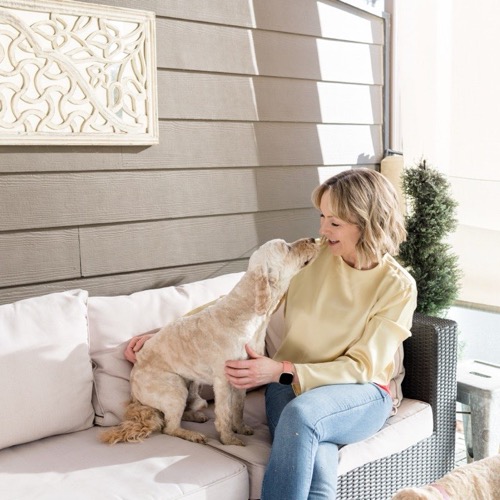
Separation Anxiety and the House Training Conundrum with Kathleen McClure
Show Notes
Struggling with a dog who soils the house? Not sure whether it’s anxiety or a house training issue? . Well, if this is your dog, you don’t need me to tell you how frustrating it is.
That’s why, in this episode I’m joined by Kathleen McClure, a Certified SA Pro who also has a partcular focus on house training.
Kathleen and I had a fascinating conversation about dogs who go in the house.
Here are 5 key takeaways:
1. What the difference is between house training issues related to anxiety and those that aren’t.
2. The importance of reinforcement and creating positive associations for desired behaviors, and why house training is no exception.
3. How to prevent future accidents and manage your dog’s behavior to set them up for success.
4. How to change your dog’s emotions and reduce fear if they only have accidents when you’re away.
5. Why some dogs may avoid eliminating in front of their owners if they feel scared or unsafe.
So, whether you’re battling separation anxiety or struggling with house training, join me and Kathleen as we dive into expert strategies that will transform your dog’s behavior.
To find out more about Kathleen and how she can help you, check out Kathleen’s self-paced online course and one-on-one coaching to get the personalized support you need on your dog’s journey to house training success. You can get more info at: https://thehappierdog.com.
For information on how to work with me, click here.
To get a copy of my bestselling book, click here.
Transcript
Download SRTIn this episode, I'm joined by Kathleen McClure. Kathleen is an expert in separation anxiety.
She's one of my certified SA Pro Behaviour Consultants, but she's also an expert in house
training. Now, when dogs have separation anxiety, one of the symptoms can be, not every dog
has this, but one of the symptoms can be that they soil the house even though they're otherwise
house trained. And that can be a problem. It's a big problem. But there are some dogs
who have house training problems where those problems aren't related to anxiety. And so
really understanding how to identify house training issues that are related to anxiety,
related to being left, and those that are related to a dog who maybe just needs a bit of a refresher
course in house training is really important. And that's why I thought let's get Kathleen on
and let's dive into that very topic.
Hello, and welcome to the Be Right Back separation anxiety podcast. Hi, I'm Julie
Naismith, dog trainer, author and full on separation anxiety geek. I've helped thousands
of dogs overcome separation anxiety with my books, my online programs, my trainer certification,
and my separation anxiety training app. And this podcast is all about sharing my tips
and tricks to help you teach your dog how to be happy at home alone too.
Hey, Kathleen, so what a topic to be talking about today, house training, and
you and I were just chatting about this before we hit record. Because this is not only something
that you worked with a ton of clients on, but it's something that's really kind of very personal
for you at the moment, because you've just moved house. And you've been employing the protocol that
we're going to talk about today. Is that right? Oh, absolutely. Absolutely. As you know,
I've done rescue for years and years. And we just recently moved and brought everybody with us.
And there's no better time to employ a house training refresher course than after a move.
And so we have been doing it hook, lines, and sinker since our move just to get everybody on
the right track. So they don't learn or develop habits that I don't want to have repeated.
So that's where we've been. And whether you have one dog, whether you have 12 dogs,
it's the exact same process. And you can just work through the plan and make the plan work for you.
And when you say everyone, tell us who everyone means, because we're not talking about a bunch
of humans, are we? We're talking about a vast group of dogs. So who is everyone?
Well, who is everyone? So it's my husband and I, although I'm the primary caregiver. So really,
it is me working through this process with our rescue dogs. We still have quite a few at the
moment. We won't go into a lot of detail. Yeah. Oh, my gosh. Brandy, Beamer, Izzy,
Fury, Dashie, and Hammy. Yay! So all of them, when you moved, it's precautionary really,
isn't it? And we're going to go into more detail, obviously, about the protocol today. But
something that I've done when I've brought dogs home is even if you're told that their house
changed, it never harms just to make sure that you're on it from the moment they're in a new
house, right? Because anything could happen. All bets can be off. Absolutely. Any dog that
comes into the home, whether it's a new foster or we bring dogs into their new home as we just did,
I start at the very beginning because it's just so important that they start off on the right foot,
so to speak, right? Let's develop the right habits. And you never know what scents are in a
new home. In this particular home where we moved, there's actually carpeting, which we didn't have
previously, which is just danger ground, so to speak. And so it was just really important to get
everybody set up for success on this. Yeah, absolutely. But one of the things I think we
want to major on, particularly in this conversation, because obviously the podcast is all about
separation anxiety, we're going to talk, aren't we, about the challenge that comes up for a lot
of people who've got a dog with separation anxiety, and that they will say, you know,
my dog is peeing or pooping when I go out. And so a big question for them and a big question that
they ask themselves and they ask of us is, but why? Why is that happening? So should we talk
about the difference between classic house training slip-ups and ones that are driven by anxiety?
Absolutely. And I think, you know, you and I both have heard this a hundred times, right? My dog is
mad at me. My dog is mad that I left. My dog is upset that I got home late from work. You know,
there's so many reasons that we as humans attribute to dogs peeing or pooping in the
home. But as, you know, a dog with separation anxiety, or really any dog, whether it's separation
anxiety or a dog that needs a house training course, it's not that they're mad at us. They're
not angry. You know, if they're working through some separation anxiety, you know, bless their
hearts. It's pure fear, stress that is causing them to lose control over those functions. And
that's got to be really terrifying, you know? And I kind of think about it like this. If I were
crying and tears were coming out of my eyes, you know, if I'm generally crying, I'm not doing that
on purpose. I'm doing it because I'm truly hurt. And the dogs who are dealing with separation
anxiety, they're not doing it on purpose. Well, no dog is doing it on purpose, but these dogs
are doing it because they're just so upset. You know, they're just so terrified to be left alone.
And we really need to acknowledge that. And I know it's hard. You know, we've all heard my dog
does it because they're angry, but that's not the case. And Jean Donaldson had this great quote that
I've used many times. I just love it. She said, for the record, I really don't think dogs view
the products of their elimination as despised trump cards in their revenge operas, right?
Right. So Jean Donaldson quote. Absolutely. Got it. Absolutely. And it's so true. And it's just
so important that everybody, whether we're dealing with separation anxiety or a dog that needs a
health training refresher, just takes to heart that, no, your dog's not doing this on purpose.
You know, either they just have to go and they couldn't get outside or they don't know what to
do, or they're just so upset that they've got no control. And that's just an outcome of their fear,
anxiety and stress. Yeah. And it's so, so exactly in thinking, you know, if we went inside their
heads, they don't want to be doing this either. But it is one of those things that's out there
that they're doing it out spite. You know, they look guilty. They know what they've done.
Oh, my God. If you're listening to this, none of those, none of those apply.
There are so many reasons to love dogs. One of my favorite reasons to love dogs is because they
aren't like us. They're better than humans. They don't do things maliciously. They don't wake up
in the morning and say, I'm going to go out of my way to upset my human. They do stuff that works
for them. And that's another Jean quote, isn't it? Dogs do what works. So for whatever reason,
you know, when they're anxious and upset, they do things, but they're not trying to
make us mad or have, you know, get back at us. So I love that you pointed that out.
Yeah, we are so much better than us.
There's no question, you know, a dog that's pining in the house that's not related to fear,
anxiety and stress. Right. Who's just under trained or under motivated.
It's not a problem for them where they eliminate. Right.
Peeing or poop's not a problem for dogs. It's a problem for us as humans because we're the ones
that have to clean it up. And we're the ones that care about our rugs and the furniture. And then,
of course, you know, we're aware of the hygiene and health issues. But none of this is a problem
for dogs. And so we've got to stop thinking that it's more than it is when a dog is peeing or
pooping in the house. And we're actually really lucky in that they do learn and they do become
quite habitual in not wanting to go in the house. I mean, you know, we take that for granted that,
you know, we've got a dog who is house trained. I mean, it's amazing until you get a dog like
my dog, India, who she won't go out when it's below, like, minus three and you know where we
live. It's below minus three. She can go 18 hours. I'm sure it's not good for her. But then the other
extreme is, I don't know if you've seen this with lots of dogs, is she will not go close to the
house. The garden, the backyard is now an extension of the house. I am not going in there.
I'm too clean. I am not going in there. OK, but you don't want to go out because it's minus five,
but you won't go in the garden. OK, let's all bundle up. Off we go. Yes. You know,
and isn't it interesting how dogs have their preferences, right? You know, I think that saying
about tall grass, you know, I had some dogs that the second they see tall grass, that is their
space and they must go, even though they just went. Other dogs that need the hard surfaces,
you know, and I see their point. Like, I don't like walking out in wet grass.
It's cold. I completely see their points. Oh, the ones who, for whom it is, it has to be grass.
And then you're walking down a high street, down a main street, and look like there's nothing.
And they find two blades of grass. It's my spot. I finally found it. Yeah,
that makes so much sense. But let's go back to this issue of the anxious ones, because
let's just point out to people, how can they tell? So one of the things I would say to them,
and I think we both asked this question is, so does this happen at any other time? So
is your dog only doing this, like peeing or pooping inappropriately when you're gone? Or
is it happening at other times? So that's my first question. I'm sure that's something that
you ask as well. Always, always, yeah. Yeah, I know. I was going to say, because then we have
that follow-up question as well, don't we? The one about, okay, but if you're in and they do it,
are they doing it right in front of you? You know, like the puppy who's just like,
yeah, I've played, I'm ready to go. Or are they sneaking off to do it?
Right, right, right. And we have to be so careful with that, right? Why are the dogs sneaking off?
What has their history been? There's a reason that they're sneaking off, because let's go back
to what we were just talking about. For them, this isn't a problem. It's not a problem for them until
we make it a problem for them. When it's separation anxiety, all games are off. All prior learning is
off. You cannot expect them to have that level of fear and anxiety and not have some kind of
physiological response. And so we really have to just look at that. And as frustrating as it
may feel sometimes, just really take it to heart and acknowledge what they're telling us.
I'm absolutely terrified when I'm home alone. I can't even control my bowels. You know,
bless your heart. And then what do you do about that, right? What's your next step? Because you
can't ignore that. And it doesn't suddenly get better. And it doesn't come out in the wash.
It doesn't just suddenly go away. It can get worse. It can get worse.
And we'll come on to that in a moment. And just to say to people, if you answer the question,
no, my dog also does this when I'm home. And then you've answered the subsequent question,
my dog does this when I'm home, but tends to go off and sneak and do it somewhere,
you know, in another room or, you know, part of the room that I can't see.
And you want to make sure that they've not just decided that they don't know where to go,
but they know it's not safe to go in front of you. Right. So that's really important, isn't it?
It is so important. And I think there's a phrase for it, you know, reverse house training,
where we've we have such big feelings about them potting inside and we get too loud or and we've
actually scared the dogs. Right. And so, yeah, it's no longer safe to potty in front of this
person. And we have to be so careful with that because it really can cause long term challenges
down the road because we need our dogs to be safe, feel safe and be safe. Right. To potty in
front of us so that we can reinforce that fabulous behavior, because we all know that reinforced
behavior goes up. And so it can really take a lot of time to undo that fear that a dog has.
Yeah. And too afraid to potty in front of you. I mean, that's just adding fuel to your
house training fire. So then let's establish that we've got a dog who either hasn't ever really
learned to go inside. So I'm going to put the anxious kids to one side for a second,
because we will come back to them because they're a passionate miles, aren't they?
We'll also talk about the ones who they've just never learned it or maybe it's a brand new puppy
or brand new rescue and you just want to be really rigorous. So the kids who've never learned
it or we don't know if they've learned it or they've had a bit of a regression. Let's talk
about how we're going to approach house training. Right, right. Well, you know, the first thing I
always say to everyone is stop blaming yourself and stop blaming your dog. Whatever's going on,
don't waste any time with that. Let's just focus on what we want to do. And more importantly,
let's focus on what you want your dog to do, what you know, because we all have in our minds,
you know, exactly what it is we'd like our dog to do. And for most people, it is to get away from
the house. You know, don't go on the pool deck or the carpet right outside the door, you know,
the doormat, et cetera. And we we need to help them learn what is important to us. And for most
dogs, what motivates most dogs, right, especially dogs that are alive, that food. And so we start to
reinforce just with everything. We reinforce the behavior we want to see more of and we are
consistent with it. And we just focus on getting the behaviors we want from our dog. And we just
stop thinking about what we don't want. And that frees us up to help them moving forward. You know,
and the other thing I think we all have to remember is that dogs are different. How many
times have we heard I've had dogs all of my life. I've never had a dog like this. Right. And, and I,
you know, I get it. I respect that. And I've kind of even honed on that a little bit more. Yeah. But
have you ever had a dog at this point in your life with all this external things in your life?
Right. I've never had a dog at this age and moved it to a new state, et cetera, et cetera. So not
only are all dogs different, but all scenarios are different and we have to let go of, I've had
dogs in my life. I've never had this problem. Great. But now we are. And so what do we do about
it? And what do you want to have happen? And what do you want your dog to do? Or more importantly,
how do you want your dog to feel? Yeah. So, so walk us through your, because I think you've
kind of got a step-by-step process for this. So let's walk through that. Oh gosh, for sure.
I, you know, I always start with, is the dog unmotivated or is the dog under trained? Like
does the dog truly understand what we want them to do? And, and how have we shown the dogs what
it is we want them to do? You know, when I ask that question to people, a lot of times they're
like, well, I've told them I've, I've, I've talked to them about it. And it, you know, dogs are so
amazing. We forget that they just don't understand what we're saying to them. You know, I can talk
until I'm blue in the face. They're just not going to get it. And so once we start reinforcing the
behavior we want, that's how we get them where we want to go. And then the other part is we prevent
future incidents of what we don't want. Right. And that's what we did when we moved here. I didn't
give the dogs an opportunity to potty anywhere other than where I wanted them to. And is it hard?
No. Is it a little colludgy and laborious sometimes? Yeah. It's a lot of management.
It's paying attention to your dogs. And for the dogs that are really struggling, we go even further
and we start tracking the data when we're having accidents, you know, at what time and also knowing
what to expect. Learning your dog's cycle really helps too. You know, if, if you think your dog is
done and you bring them inside and then Shazam, they, they poop on your carpet, it will, that's
not your dog being difficult. Right. That was us probably coming in too soon. Not all. Yeah. Not
seeing the signs from the dogs. And so it's all of those things, you know, it's the prevention,
it's the reinforcement, it's the management and it's not complicated, but it is, it is time and
effort. And I always tell people you won't be dealing with this challenge forever. Right.
Just work through this process or you can keep baffling along as you have been and,
you know, get some half-hearted results or, but if you really commit to the plan and the process,
yeah, you're probably going to see some, some improvement. And there's always those caveats,
you know, we have to ask those questions about our senior dogs. You know, if it's an adult dog
that has suddenly started having health training issues, my first recommendation is let's get
checked by a vet, you know, an adult dog. Yeah, for sure. So important that we've looked at,
is there a medical cause for this? It's not that you were gone too long yesterday or you've been
working extra hours. Let's look at some other potential real causes for dogs having changes
in their behavior. Gotcha. So let's talk about the plan then. So you mentioned the first thing is
we're going to decide where we want them to go. So as simple as that. So we're going to decide,
is it on the walk? If you've got a yard, is it a particular part of the yard? So first of all,
decide where you want them to eliminate. Absolutely. And once we decide that, then
that's where we continue to go and that's where we're reinforced. You know, and a lot of times,
dogs are offering us great behaviors and we miss it and we don't reinforce it, right? I mean,
it's really common to see dogs going, eliminating out on walks. But what's not as common is seeing
the humans reinforcing that behavior. And it's so important that a dog who is struggling with
house training, that we're reinforcing every single time that dog offers that behavior in
a place that we're hoping for, right? Whether it's out in the grass or further away or only on walks.
Again, every dog, every family is different. So that's where determining what's important for you
and your dog and your family is going to get you for the success that you want.
So by reinforced, we're talking about having yummy treats ready and accessible so that when they do
go where we want them to go, we can have a party and we can praise them and treat them and it's
amazing and well done. So that's what we mean by reinforced, right? That is absolutely what we mean.
And I mean, I take that a step further. Let's set yourself up for success, right? Don't put your
delicious treats in the cabinet or cupboard far from your door, right? Set yourself up for success.
Make it easy to get it right for everybody. So you have your treats right next to your leash.
Or for me, I will have my treats by every single door. I have treat stations. So no matter what
door we're going out, it's easy for me to get it right. And so I can help them learn what I
want them to do. So yeah, reinforcement is critical. It's kind of like our way of saying
to the dog, yes, more of that. Let's see more of that. Do that. And I kind of imagine if you
and I were just sitting here, $100 bills just started falling down from the sky. Well, we may
not know why, but we're both going to start evaluating what do I need to do to make that
happen again, right? And it's the same thing for the dog. I don't know why I'm getting this amazing
treat party, but I love it. And so with consistency, they start to figure out, oh,
okay. So I go out here and amazing things happen. And when I don't go out here,
amazing things don't happen. And just that in itself can really start to help them
put the pieces together since they don't speak our language.
Absolutely. And then the next thing I guess we need to do is we worked out where they want to
go. We're rewarding them when they go in the place that we define as being right.
And then you talked about management. So we need to make sure that we like, you know,
how they reduce, but like get to zero, the opportunities for them to go in the wrong place.
So we need some management. Right. And that can take some time and effort, you know, for us as
humans. The first question I ask people is your dog crate training. And if they're not, that's
fine. We don't have to use a crate. We do have to manage them at some level, i.e. we have them on a
leash tethered to us in the house or they're right next to us or there's a baby gate. But I always say
to people, your dog's not in trouble. We're setting them up for success. And so by preventing that,
we're setting and you know, for some people, it's is your dog on your lap, your dog sitting right
next to you on the couch, whatever the case, but don't give your dog an opportunity to hop
off the couch and sneak around the corner or or even do it right in front of you, whatever.
Keep them with you. And that's the management piece. And that can be challenging for people
sometimes. But we work through that. There's always a way. There's always a way to to keep
them with us. And then the other piece that we kind of forget about is there's a physiological
aspect, especially for puppies and so forth. The dogs are having to learn how to hold it. Right.
That doesn't just happen. That's there's muscles involved there. And and going out more often,
right, is not a house training strategy, because then they're not learning how to hold it. And
that's important. And that's where the delicious treats come in. Right. If I can just hold this
until we can get outside, I'm going to get that all that amazing goodness. And that helps them
start to learn and set them up for success. You know, if I'm going to run a marathon, I'm not
going to go outside and run 26 miles today. I'm going to walk around the block, right,
depending on where I am. And if your dog's never gone more than 35 minutes without a potty break
outside, you know, we slow incremental increases in the duration in which we ask them to hold it.
And so there's some fine tuning that we need to do to make sure that we're setting them up for
success. But again, you know, it's it's not complicated and it's not something you'll be
dealing with the rest of your life more than likely. It's just some work that you need to
do in the beginning. Absolutely. Yeah, totally agree. So what advice have you got for people
when they've worked out where they want their dog or puppy to go, they're doing the rewards,
they've got the treats by the door, they're watching their dog or puppy like a hawk,
but then there's an accident in the house, there's a slip up. So, you know, while this
isn't an anxious dog, we're talking about a dog who's just gone, oh, you know, I'm going to go
here, it's easier. So what do people do then? Yeah, so and that's a great time to really,
really reevaluate. Well, A, how did your dog have that opportunity, right? And life happens,
you know, did you get a phone call with somebody not managing the dog or you thought your husband
was but he wasn't because he thought you were, you know, there's some data tracking, I think,
that is really helpful in helping dogs learn when to go because if there is an accident in
the house, that's data that tells us, okay, we weren't outside long enough or maybe there is
an inordinate amount of urination, do we need a vet visit, right? And so there is, I don't think
anyone ever, I certainly didn't, really thinks about the data tracking that can be so helpful
so that we see those trends, so we know what the problem is. Like one accident does not indicate
a problem other than it says there was a management slip up, what do we need to do to make
sure that that doesn't happen, right? But it also allows us to see trends, you know, oh, wow, my dog
does go, you know, consistently this time of the day, every day, I need to stay out a little bit
longer with the dog because they haven't yet gone and, you know, that brings up a great point
for people with a fenced-in yard, you know, what a gift to have a fenced-in yard. Your dog can go
out and play and be by themselves and you don't have to worry but when you're house screening,
those fenced-in yards are not really a big benefit for you. You need to be out there with your dog,
right, to make sure that they didn't get busy sniffing and doing other things and they
forgot to go, right? And so what happens? They come in the house and they go because they were
so excited outside they forgot to go. So if you're not out there managing them outside as well,
you're missing some key components and could miss some, A, the biggest part, miss your opportunity
to reinforce the behavior you wanted to see more of, right? If you're not right there to tell your
dog, great job, great job, here's my, here's your jackpot, a treat, then your dogs learn nothing.
Such a good point. Yeah, such a good point. Again, it's just like that. It feels like a lot of work
but you can't emphasize enough how it's a period of really intense focus that compared to the
lifetime of the dog isn't very long at all. It's an intense burst of managing this process to get
a dog that for the rest of their life will be, you know, completely solid when it comes to house
training. So it's a lot of, yeah, it's a lot of effort but it's a short period of time, right?
Yeah, it is. I think we also have to just go back to the, you know, all dogs are different and
there are some dogs that really do struggle with this more than other dogs and, you know, I think
those humans are feeling really inadequate, really upset, wondering what's wrong with their dog,
wondering what's wrong with them and I just think we have to just take that moment and just go back
to every dog is different and, yeah, it might be longer for your dog or you might have to keep up
the reinforcement schedule longer for this dog than you have other dogs but that's okay and to
just give everybody a little bit of grace, you know. At any given time over the last several
years, not now of course anymore, you know, we had 12 dogs and we were fostering 12 dogs at any given
time in our home and all the dogs were different, you know. I had some dogs who would literally,
kind of like what you were talking about with India, would not go inside just to save her life.
She would never do it and have other dogs who were just like, you know, it's really just been
a little bit too long for me, you know, and so every dog is different and so every dog needs
a different level of reinforcement just like all humans are different, you know. What is reinforcing
for me may not be reinforcing for the person sitting next to me and so the learner determines
what's reinforcing. So if we're struggling, maybe the treats you're using aren't that fabulous
from your dog's perspective, you know, we need to change that up or maybe they're getting them
too often. So there's so many tweaks and things that if your dog is struggling, you're not alone.
It's very common. People don't talk about it a lot because it's embarrassing. They feel like
something's wrong with them or wrong with their dog but you're okay. You've got, there's ways.
There are humane ways to help your dog through this process. So really take the time to give
yourself some grace and give your dog some grace. Everybody's trying at different levels. Exactly,
that's so true. So let's then talk about the dogs who are anxious. So dogs who eliminate
almost solely, well let's say solely, when their humans aren't around and it's 100% related
to absence. So I think you and I both say exactly the same thing on this.
This isn't about house training. So this isn't go back and look at your house training protocol.
This is about stop the emotion because it's a behavior that's resulting from the emotion of
being left. So we have to change the emotion, right? Right, stop the emotion, right? We don't
want them to be in the position to feel that fearful that they then urinate or defecate in
your house, right? So of course, yeah, we would obviously say the exact same thing. What can we do
to prevent your dog from feeling that fear? When you change how a dog feels, you change how they
behave. Just as simple as that. And if they're not terrified by being left alone, guess what?
Then they don't need to urinate or defecate in their house when you're gone. Yes, exactly. And
so it's not about going back to basics with, you know, reward for going out. I mean, it is
change the emotion. So this is a very different problem. It presents very similarly,
but it's not the same thing. So yeah, I mean, and you can think about all the house training
protocols in the world. And the thing about these dogs is because they're only going when people are
out, they're usually brilliant the rest of the time. You know, literally people will say, I don't
understand this because he never goes in the house. You hear that a lot, don't you? I don't
understand. He's really, really good. She's great. She always goes on the walk. So you hear that a
lot, don't you? With dogs who get anxious and that's the driver. Absolutely. You know, and
that's such a strong predictor. Yes, this is truly the only time your dog's going in your house
is when you're gone. Well, how can we help your dog feel more comfortable when you're gone?
So they don't have to do that any longer, you know, and I think you made such a great point
earlier, especially dogs who are reliably house trained, they don't want to go inside. So imagine
how horrible they're feeling that they've just done something they didn't even want to do on top
of all the fear and stress. That is heartbreaking to think of it like that. Yeah. Thank you for
bringing it back to how the dog feels because that is, yeah, they, when they really get,
as most dogs do, you get, eventually you get really good at knowing when they want to go,
where they want to go. It's horrific for them if they have to go, like when they've got an
upset tummy. I mean, see how anxious and stressed they get when they've got a really long tummy and
they're just like, I just need to go out. I just need to go out quick, quick, quick. I mean, yes.
They do anything not to go in the house when they, when they feel like it.
Right. Well, and I kind of equate that to us, right? You and I, we would do anything in the
world to prevent having an accident, right? And dogs are the, and here's the thing, we have so
much more control over our lives and they just don't. So the, what's the word I'm looking for?
The desperation to get out for them is, is even more. And so, you know, a dog that's urinating,
defecating in a house only when their human is gone is such a flag for a dog saying,
please help me. You know, please, please help me. And it's hard for the humans. No one will ever
take away for how challenging it is for the humans too. It's a challenge for everybody.
It's hard on everybody's heart, that's for sure. And obviously there's lots of other episodes about
that that people can pick up on. So they can flick through the other episodes in the podcast.
So if they're dealing with a dog whose elimination is due to anxiety. So any final thoughts then on
house training and also if people want to get your help, where can they go?
Yeah. So, so the final thoughts I have are really, again, be kind to yourself, be kind to your dog.
You more than likely are not going to be dealing with this challenge forever. There are humane,
empathetic ways to help your dog learn what you want them to do. I work with people on this in a
variety of ways. It just depends on what type of learner you are. Everybody is different. I'm going
to have a self-paced online course where people can go through it on their own at their own time
and then ask questions in a Facebook group, get the support that they need in a private Facebook
group. And other people are just like, I don't want to do that. I want, I want a human to tell
me what to do. And that's where, you know, I do do one-on-one coaching for people so that they
really have all of that support that they need. You know, I offer people tech support and email
support in between because this is hard. And sometimes you just need someone that you want
to vent to. And so that's how I help people. They have those two choices. You know, they can
do it themselves and ask questions online, or they can work one-on-one with me. And both of
those options are available on thehappierdog.com. I was just going to say, I will link to that in
the show notes so that people can click and get straight through to you. So Kathleen, as ever,
a real joy to chat to you today. And I think you've provided such help and brilliant tips for
people who are struggling with this. And just a reminder as well, I think you've really reminded
us all to, you know, keep thinking about the dog's perspective in all of this, because as hard as it
is for us to have a dog who's toiling the house, it's really tough on them too. But it's, I think
you've given us all hope and given us a clear plan forwards. Oh, well, I certainly hope so.
There is hope. So take it and you're not alone. And just know that there's help available. You've
got this. You've got this. Thank you so much, Kathleen.
Thank you so much for listening to this episode of the Be Right Back
Separation Anxiety podcast. If you want to find out more about how I can help you further,
head over to julienaysmith.com. Meanwhile, if you enjoyed listening today, I would love it if
you would head over to wherever you listen to your podcasts and consider rating my show.
Thanks so much. Good luck with that training and bye for now.
Need help with separation anxiety?
Join the Be Right Back program and get the support you need.
Start helping your dog today